
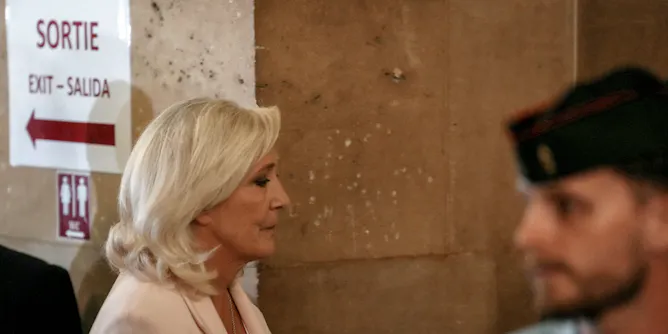
Marine Le Pen was found guilty of misusing EU funds, but her eligibility to stand in the presidential election remains intact. Luc Rouban, Emeritus researcher at Sciences Po’s CEVIPOF, weighs in on the verdict.
Articles on French elections
Displaying all articles

Under France’s second-ballot system, French voters can vote with their hearts in the first round, knowing they’ll be able to vote in the second round with their heads — in other words, strategically.
If political parties respect voters and focus on policy rather than polls and partisan hackery, Canadians might have something substantive to choose from when the next federal election is called.

The ‘cordon sanitaire’ is a strategy used across Europe to try to exclude political extremes from the mainstream.
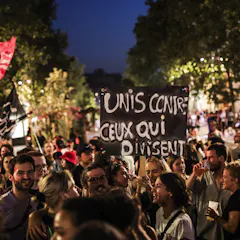
The latest surprise results have seen a left-wing coalition take the lead, but no party will be able to form a parliamentary majority.

Polling hasn’t improved for the UK’s Conservatives throughout the campaign. meanwhile, French President Emmanuel Macron appears to be heading for electoral disaster.
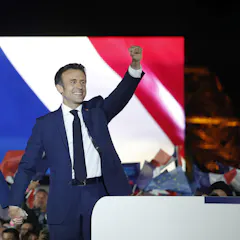
France faces multiple problems at home and on the world stage.

With the collapse of traditional politics, voters must vote with their heads rather than their hearts at every stage.
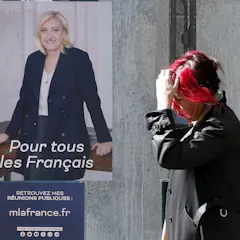
French voters face a stark choice at the polls, but many are saying ‘non’ to both candidates.
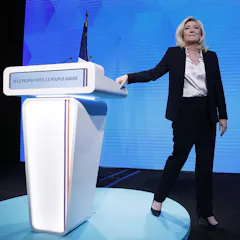
Jean-Luc Mélenchon was the great success story of the first round. The question now becomes – who gets his votes in the second?
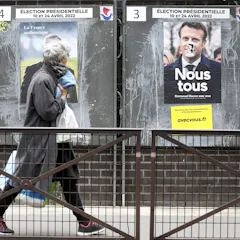
For the second time running, it is looking like the French presidential election will go to a runoff between centralist Emmanuel Macron and far-right Marine Le Pen.
Top contributors
-

Professor of Politics, Queen Mary University of London
-
Associate professor and Founding Fellow, MacEachen Institute for Public Policy and Governance, Dalhousie University
-
Directeur de recherches (CNRS) au Cevipof, Sciences Po
-
Professor of Critical Cultural & International Studies, Colorado State University
-
Hurst Senior Professorial Lecturer, Co-Director Transatlantic Policy Center, American University School of International Service
-
Associate Professor, School of History, ANU / Chercheur Associé at the Centre d’Histoire de Sciences Po, Australian National University
-
Professor of International Politics and Director of Department of Politics and Public Administration, University of Limerick
-
Senior Lecturer in International Relations and Politics, Aston University
-
Associate Professor in French and Francophone Studies, University of Nottingham
-
Election Analyst (Psephologist) at The Conversation; and Honorary Associate, School of Mathematics and Statistics, The University of Melbourne
-
Ph.D. Candidate in Communication, University of South Florida
-
Research Fellow, Electoral Studies, Political Science, Université de Montréal