

There are different tactics that governments can use to block the internet, some more sophisticated than others.
Articles on Freedom
Displaying 21 - 40 of 89 articles
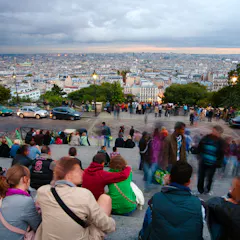
Saying the state upholds universal principles does not act as a safeguard against institutional discrimination and racism.

Ties between the two nations date back to Tanzania’s solidarity with the anti-apartheid struggle.

Science fiction does more than entertain – it can also be used to better understand the political forces that shape the societies in which we live.

The Bush administration invaded Iraq with plans for it to become a democracy. But according to some social science measures, the country isn’t any more democratic than it was before 2003.
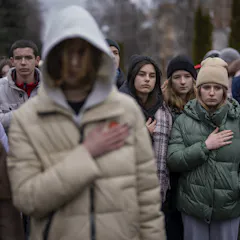
Maintaining a functional and lively civil society in Ukraine is crucial to keeping supplies moving and keeping up the morale of the country.

As the year ends, how has New Zealand fared on global and domestic measurements, from social and economic freedoms to tackling poverty and homelessness?

Messages about climate change must be adapted to people’s histories, differences and expectations.

A scholar of gun culture looks at the roots of Americans’ love affair with firearms – and their willingness to accept gun violence as a price of freedom.

When it comes to dealing with Uber’s difficult working conditions, Uber drivers are on their own.

Music has often been used as a political tool to urge Kenyans to forget the sins of colonial and post-colonial regimes.

Our freedom is limited as soon as our speech and behaviour become harmful to other people.
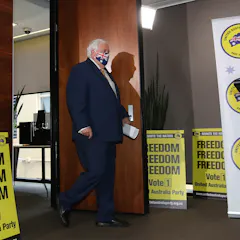
New research shows a large percentage of Australians value “freedom” as the most important human right – but politicians need to offer a more sophisticated version of that ideal.
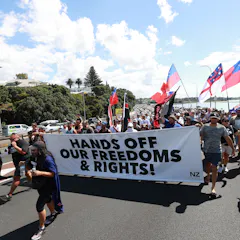
There is a difference between ‘negative liberty’ and ‘positive liberty’. Real freedom involves unavoidable trade-offs between the two.

The convoy’s comparison of Canada’s current government to Nazi Germany draws on previously existing statephobia.

The Canadian Constitution compels a proportionate weighing of all Charter rights against the threat of COVID-19, meaning that individual freedom is not absolute.

Participants in the “freedom convoy” have been allowed to carry on with minimal police and state interference in contrast to how Black and Indigenous protesters have been treated in the past.
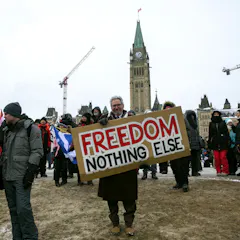
‘Freedom convoy’ protesters are turning the language of freedom against their own governments. The implications and repercussions of this are enormous.

Instead of a self-serving, diesel-stinking, neighbourhood-clogging mob that negatively impacts the freedom of others, the convoy should consider going home and learning about different perspectives.

Many countries, including South Africa, use regulations to control smoking in public so that they do not harm non-smokers. Likewise, getting vaccinated is for the common good of society.
Top contributors
-

Lecturer and Teacher, Department of Politics and International Relations, Cardiff University
-
Assistant researcher, University of Sydney
-
Associate Professor in Clinical Psychology and Neuropsychology, Trinity College Dublin
-
Professor of Law, University of Waikato
-
Professor and Chair of History Department, Colorado State University
-
Extraordinary Professor, Department of Political Sciences, University of Pretoria
-
Sarah Joseph is a Friend of The Conversation.
Professor of Human Rights Law, Griffith University
-
Senior Lecturer in Law, Charles Sturt University
-
Senior Lecturer in Politics, University of Exeter; Independent Social Research Foundation
-
Lecturer, Faculty of English, University of Cambridge
-
Assistant Professor of Digital Communication, The University of Texas at San Antonio
-
Professor of Politics, University of Sydney
-
Professor of Political Theory, Loughborough University; Independent Social Research Foundation
-
Professor, University of British Columbia
-
Associate Professor , Brac University