
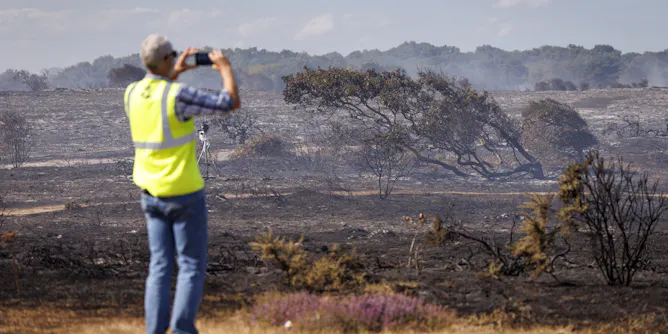
An ecologist explains what happens next.
Articles on Fire ecology
Displaying all articles
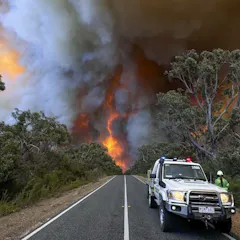
Much of the Grampians National Park (Gariwerd) has already burned this summer – and the fire is not out yet. What does this mean for the animals that live there?

Humans have become a geologic force by cooking the planet – using fire on a scale that is altering land, water, air and ecosystems.
Zombie fires smoulder through the winter and reignite in the early spring. How these fires behave is not well understood, but they can contribute to an earlier and longer fire season.
New research shows boreal forests comprised 23% of global wildfire emissions in 2021, up from 10% in a typical year.
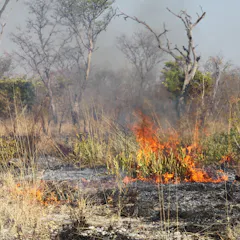
Understanding fire history is crucial to designing effective fire management in order to maintain biodiversity and support the livelihoods of people.

Arctic heat waves were once rare and unusual events. But as their intensity and frequency increase with climate change, their fallout could affect the north — and the planet — for decades to come.
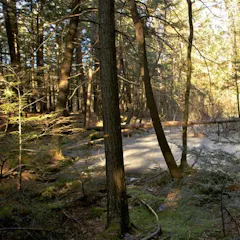
Evidence shows Native Americans in New England lived lightly on the land for thousands of years. It wasn’t until Europeans arrived that the landscape experienced major human impacts.
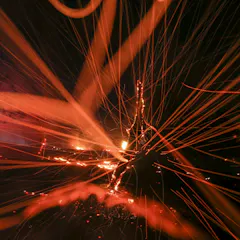
The Earth may be entering an era in which natural and human-generated fire together are reshaping the planet.
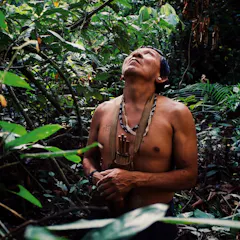
Fire doesn’t have to be destructive. For many in the Amazon, it is part of their livelihood and culture.
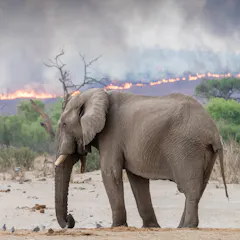
Yes, there are more fires in Africa than Brazil. But unlike the Amazon, Africa’s savannah has evolved to grow back quickly.
Top contributors
-

Emeritus Professor of Life Sciences, Arizona State University
-
Professor of Ecology, University of York
-
Professor, University of Colorado Boulder
-
Dean of the Harpur College of Arts and Sciences and Professor of Anthropology, Binghamton University, State University of New York
-
Director, Harvard Forest, Harvard University
-
Research associate, Department of Integrative Biology, University of Guelph
-
Professor of Environmental Science, Emerson College
-
Associate Professor Plant conservation unit, University of Cape Town
-
Associate Professor, Faculty of Science, Earth and Climate, Vrije Universiteit Amsterdam
-
Professor of Environmental Geography, Royal Holloway, University of London
-
Research Officer, Geography Department, Swansea University
-
Postdoctoral Research Fellow, African Climate and Development Initiative (ACDI), University of Cape Town, University of Cape Town
-
Professor and Canada Research Chair in Forests and Global Change, Wilfrid Laurier University
-
Director of African Climate and Development Initiative, Professor in Environmental and Geographical Science, University of Cape Town
-
Associate Professor in Wildlife and Conservation Biology, Deakin University