
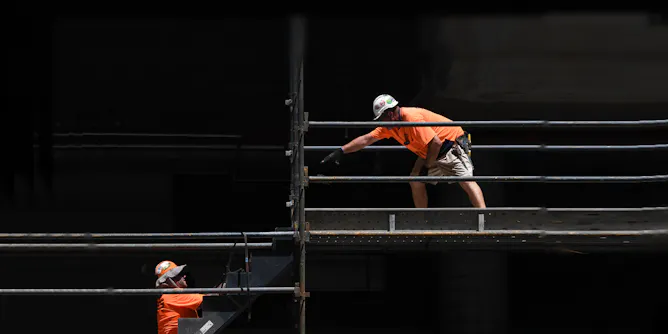
The Australian Building and Construction Commission fined the CMFEU $16.1 million over six years. Axing it has removed a check on bad behaviour.
Articles on Fair Work Commission
Displaying 21 - 40 of 106 articles

The Fair Work Commission’s general manager, Murray Furlong, is moving for the appointment of administrators into the construction division of the CFMEU, following a string of allegations.

Increases in award wages do very little to boost Australia’s total wage bill, and even less to boost inflation.

Dental assistants, community services workers, pharmacists and psychologists are in line for biggger increases down the track.

The tax cut will be worth $52.60 per fortnight for an Australian on the median wage. Next Monday’s pay rise might be worth another $65.50.

Most of the indirect care workforce will only see a pay rise between 3% and 7%.

While wage rises for aged care workers are welcome, this measure alone will not fix all workforce problems in the sector.

The Fair Work Commission has been given new tools. Among them is the power to eliminate gender-based undervaluation of work in entire awards and groups of awards.

If an organisation mandates their workers return to the workplace – whether exclusively or in part – it needs to provide clear guidelines.

Our research shows that aged care work is still stigmatised by other health professionals as dirty, difficult and low-status – more than most other jobs.
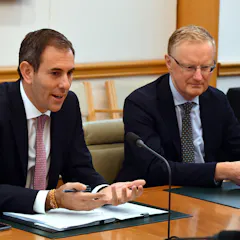
Chalmers is in the driver’s seat as another Labor government copes with an economic crisis – very different from the GFC, but similar in being driven by circumstances not of the government’s making.

Will the decision to grant a 5.75% increase in award rates add to inflation and increase interest rates, making many of us worse off? Well, no.
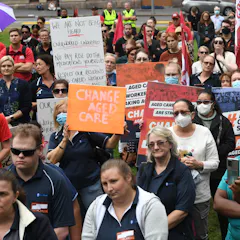
Treasurer Jim Chalmers said that “for too long, those working in aged care have been asked to work harder for longer without enough reward, but with this budget that changes”

Federal Labor made an election promise to criminalise wage theft. But there are better reforms more urgently needed.
Despite the controversy over multi-employer bargaining, higher wages are likely to come from other provisions in the Albanese government’s Secure Jobs, Better Pay Bill.

For more than a decade, employers have strung out negotiations or let agreements expire. Known as “zombie agreements”, those deals mean too many Australians are living with wages frozen in the past.

The Albanese government’s industrial relations reforms will help avoid protracted industrial conflict, but more is needed.

Deliveroo says it has been unable to achieve a sustainable position in the Australian market.
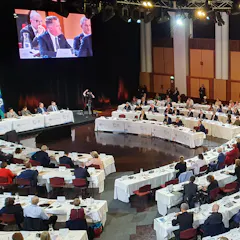
A comparison of 17 OECD countries shows those with multi-employer bargaining had worse wage outcomes than those enterprise bargaining.
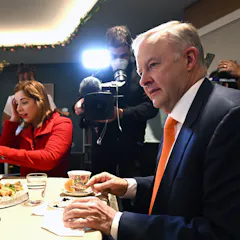
Governments budget in billions. Yet analysis prepared for The Conversation shows they’ve been extraordinarily stingy with pay rises – particularly when it comes to teachers and nurses.
Top contributors
-

Professorial Fellow, University of Canberra
-
Visiting Fellow, Crawford School of Public Policy, Australian National University
-
Senior Lecturer, Management and Organisations, UWA Business School, The University of Western Australia
-
Associate professor, University of Sydney
-
Senior Lecturer, Management and Organisations, The University of Western Australia
-
Professor in Working Life, Discipline of Business Information Systems, University of Sydney Business School, University of Sydney
-
Professor of Work and Regulation, Queensland University of Technology
-
Laurie Carmichael Distinguished Research Fellow at the Centre for Future Work, Melbourne; and Professor Emeritus, Griffith Business School, Griffith University
-
Economist and Director, Centre for Future Work, Australia Institute; Honorary Professor of Political Economy, University of Sydney
-
Associate Professor of Workplace and Business Law, UTS Business School, University of Technology Sydney
-
Associate Professor in Managing People and Organisations, University of Sydney
-
Associate Professor, Director of the Centre for Employment and Labour Relations Law, The University of Melbourne
-
Professor of Labour Law, University of Sydney
-
Professor Emerita, Law, University of Sydney
-
Associate Professor, School of Management, Curtin University