
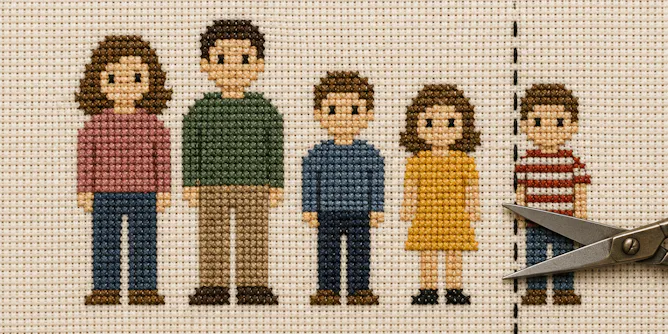
Estrangement is rarely caused by childhood abuse or a pushy therapist. Instead, it reveals a collision between two ideas of what family should be.
Articles on Estrangement
Displaying all articles

Tensions like those reported in the Beckham family expose a quiet truth: family bonds are not guaranteed.

Every time we choose people over convenience, we invest in community. The real question in our homes, workplaces and democracies is whether we are willing to pay that price.

This time of year can bring a resurgence of grief about facing Christmas without family.

What makes Brooke Hogan’s case unusual is that she asked to be disinherited to avoid a court battle over her celebrity father’s estate.
Not all of us get to grieve a stable and warm relationship. We may feel complicated emotions beyond sadness.
The advantages of being a part of a family are so obvious that losing that affiliation, intentionally or not, is tragic.

Family estrangement feels shameful and isolating: but if you’ve experienced it, you’re far from alone. Sharing true stories can help reduce shame and create awareness.

Some parents engage in domestic abuse by influencing their children to fear, dislike or distrust their other parent. What happens next is a cascade of losses.

Contrary to society’s celebrations of family togetherness, the ‘ties that bind’ often become frayed or broken.

A researcher who studied family estrangement identifies the main reasons behind it and how people can find a path to reconcile and heal family rifts.

Family courts’ hostility – both in the US and abroad – toward claims of paternal or spousal abuse has been widely reported. Now there’s an in-depth study that documents that hostility.

There is a common misconception that family estrangement is a particular event or outcome. Rather, it’s often based on ongoing issues.

Connection with others is vital to our well-being. For many people, though, connecting with family members who have hurt us, or whom we have hurt, is difficult. A psychologist offers some advice.
Top contributors
-

Associate Professor, School of Behavioural and Health Sciences, Australian Catholic University
-
Adjunct Faculty in Industrial and Organizational Psychology, Adler University
-
Casual Academic, Creative Writing and English Literature, Flinders University
-
Associate Professor of Applied Social and Health Psychology, Colorado State University
-
Professor of Psychology, Gonzaga University
-
Hazel E. Reed Human Development Professor and Professor of Gerontology in Medicine, Cornell University
-
Associate professor, Department of Communication, University of Washington
-
Associate Professor of Human Development and Family Studies, Iowa State University
-
Professor of Law, George Washington University
-
Associate Dean for Education and Student Experience at Aston Business School, Aston University
-
Associate Professor of English, Drake University
-
Professor of Psychology, Curtin University
-
Distinguished Professor of Law, Rutgers University - Newark
-
Professor of Law, University of Virginia
-
Professor of Sociology, The Ohio State University