
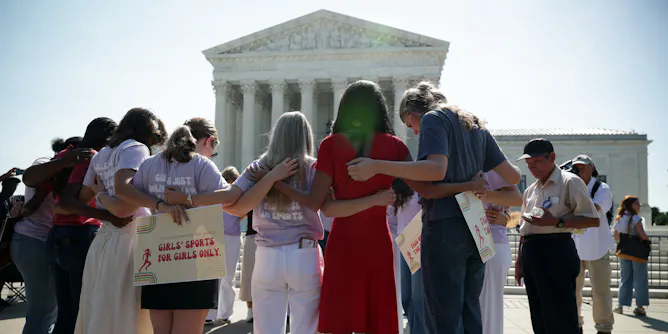
The Supreme Court’s rulings on Little v. Hecox and West Virginia v. B.P.J. focused on transgender students participating on sports teams, but likely has broader implications.
Articles on Equal Protection Clause
Displaying all articles

The Supreme Court’s ruling that a Black-majority voting district in Louisiana is unconstitutional adds to a long and dismal history of government attempts to limit the power of minority voters.

Redefining sports eligibility around gender identity risks erasing the protections that have helped women’s college sports flourish, a scholar argues.
The Supreme Court’s decision about a Tennessee law banning gender-affirming medical care for trans youth will determine how strongly the equal protection clause protects trans people.

A Georgia election law scholar explains what’s behind the ruling and what it means for the state’s prosecution of Trump.
The Supreme Court’s decision to ban affirmative action programs reverses nearly 50 years of its own decisions that ruled diversity was of vital national importance.

One of the bedrock principles of the American legal system is that no one is above the law. When it comes to indicting a former US president, political factors must also be weighed.

President Lyndon Johnson’s commencement address at Howard University in 1965 offered a compelling argument on the need for affirmative action. His policies have been challenged ever since.

The GOP is hoping the ghosts of Florida past will tilt the race in Trump’s favor. But Joe Biden’s apparent electoral lead in numerous key states may insulate his win from such legal challenges.
A 6-3 conservative court will hear a broader range of controversial cases, shift interpretations of individual rights and put more pressure on local democracy to make policy decisions.
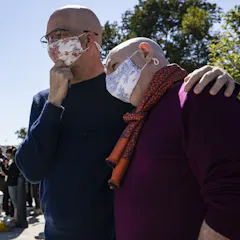
Ruth Bader Ginsburg’s death sparked many tributes to her work ending sex discrimination against women. That work also paved the way for successes in the fight for equal rights for the LGBTQ community.
Top contributors
-

Adjunct Professor of History, University of North Carolina – Charlotte
-
Clinical Professor of Law, Director of the International Human Rights Clinic, Rutgers University - Newark
-
Professor of Law, Harvard University
-
Professor of American Civics, University of Tennessee
-
Lenore Stern Professor in the Humanities and Social Sciences, Tufts University
-
Assistant Professor of Law, Georgia State University
-
Law Professor in Constitutional Law, Criminal Law, Election Law, University of Memphis
-
Associate Professor of Philosophy and Law, Wayne State University; Institute for Humane Studies
-
Associate Professor of Recreation and Sport Management, Coastal Carolina University
-
Assistant Professor of History and Africana Studies, University of Tennessee
-
Professor Emeritus of Legal Studies and Business Ethics; Faculty Director, Wharton Coalition for Equity & Opportunity, University of Pennsylvania
-
Associate Professor of Law, Wake Forest University