

Making and analyzing art helps students learn English on a more personal and emotional level than traditional approaches do.
Articles on English as a second langauge
Displaying all articles

The federal government’s web portal for reporting cybercrimes is of little use if you have limited proficiency with English.

Our research found non-native English speakers face higher rejection rates and 12.5 times more revisions than their native English-speaking counterparts. But there are solutions.

COVID public health measures included school closures and a shift to online learning. This placed immigrant families at a disadvantage as they saw to their children’s emotional and educational needs.

How we teach languages has not evolved much from the traditional grammar-based mode of instruction, and this approach alone marginalizes students’ existing knowledge and communication abilities.

Despite reports that multilingual students’ academic progress has ‘stalled,’ researchers find new reasons to be optimistic about how they are faring in US schools.

Difficulty with English language can mask other difficulties culturally and linguistically diverse students may have, such as Austism or dyslexia.
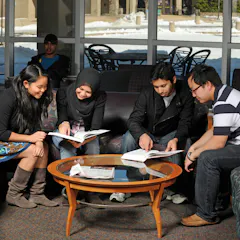
Without developing a better understanding of the challenges refugee students face, we run the risk of further disadvantaging refugee students in Australia.

Having English as a common language can and does lead to problems.

Child refugees talk about their experience of transitioning into a new high school in Australia.
Top contributors
-

Associate Professor, Migration and Education, Australian National University
-
Professor of Cognitive Neuroscience, Bangor University
-
Senior Lecturer in the School of Psychology, Adelaide University
-
Associate Professor of Literacy Education, New York University
-
Sessional Lecturer in Language and Literacies Education, The University of Melbourne
-
Deputy Chair, Academic Board; Dean International, Faculty of Health Sciences, and Professor of International Health, Curtin University
-
Associate Professor, School of the Environment, The University of Queensland
-
Doctor of Education Candidate, Department of Education, University of Bath
-
Doctoral Student, Curriculum Studies, University of Saskatchewan
-
Associate Professor of Criminology, University of South Florida
-
Professor of Education, Lakehead University
-
PhD Candidate in Social Justice Education, University of Toronto
-
Assistant Professor of Education, Oregon State University
-
Postdoctoral Research Fellow, Educational Studies, University of Windsor