
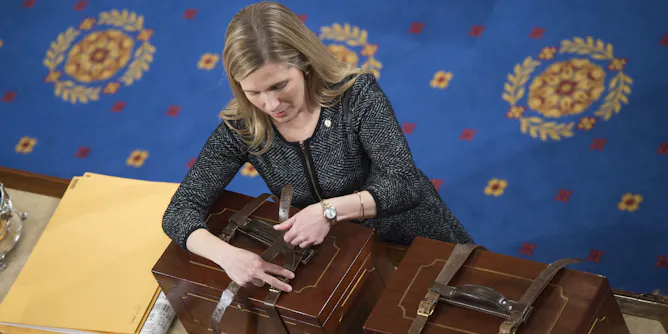
With a Supreme Court ruling rejecting one of the founders’ two reasons for creating the Electoral College, only one reason remains: racism.
Articles on Electoral College
Displaying 61 - 79 of 79 articles
Mathematically speaking, the Electoral College is built to virtually ensure narrow victories, making it very susceptible to manipulation and disinformation.
Many Americans are surprised to learn that Electoral College members do not necessarily have to pick the candidate their state’s voters favored. Or do they?
There are many more ways to elect a president than the US method – and several alternatives beyond the popular vote.

Hillary Clinton got the most individual votes from US citizens in 2016, but Donald Trump won the most electoral votes.

A quirk of mathematics gives voters in some small states, like Rhode Island and Nebraska, an extra edge over voters in other states. This happens not only in the US, but in other countries, too.
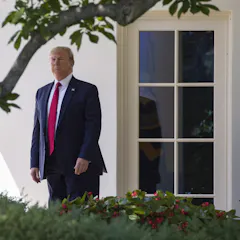
Throughout the course of American history, peaceful transitions of power have been the result of choices made by individuals, not the U.S. political system. What does that mean if Trump loses in 2020?

Conflict made its way to the Supreme Court this past session with two cases – one about the census, the other about gerrymandering. A court scholar says the two cases are intimately connected.
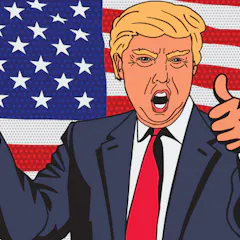
Many were confident the US Constitution was robust enough to check Donald Trump’s worst excesses, but the real push back has come from elsewhere.
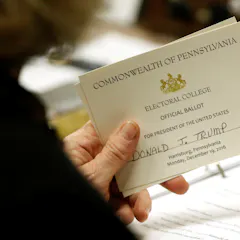
Does the Electoral College encourage candidates to campaign in rural areas, as its supporters claim? And do electors actually filter the ‘passions’ of voters, as the founders wanted them to?
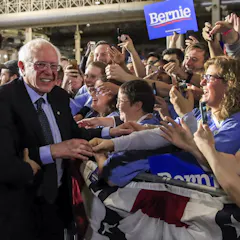
The Democrats have 24 potential presidential candidates but, like Donald Trump, their two front runners are both men in their seventies: Bernie Sanders and Joe Biden.
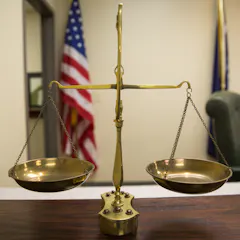
The 2016 election made clear that the Electoral College does not weigh votes from all states equally. A new analysis suggests the power of your vote is closely linked to voter turnout in your state.
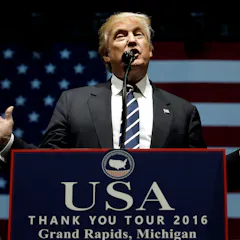
The Electoral College has survived 227 years and, arguably, has never truly been needed. Now would be a good time to use it.
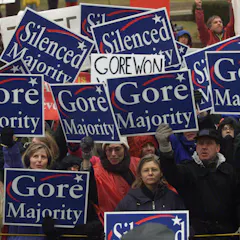
With two of the past five presidential election winners losing the popular vote, it’s hard to justify the continuation of the Electoral College.
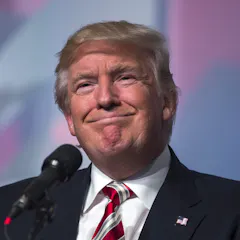
Swinburne political scientist Bryan Cranton looks at why so many experts got the US Election so wrong
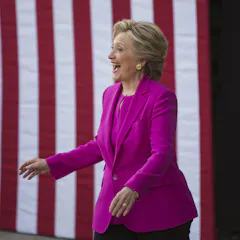
Swinburne University political scientist Bryan Cranston makes his final US Election Day predictions.
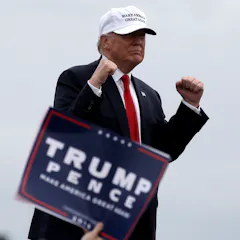
There has been much analysis on the rise of Donald Trump as the result of widespread social and economic unrest, but a look at the primaries shows it to be more of a quirk of the system.
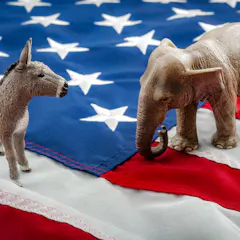
Ever wondered how the US president is actually elected? Here is a basic guide to the electoral college system.
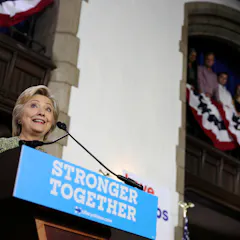
Global audiences have heard of US election terms like the primaries, the conventions and the Electoral College. But the history and exact meaning of these terms remains a mystery to many.
Top contributors
-

Professor, Political Science Department, College of the Holy Cross
-
Election Analyst (Psephologist) at The Conversation; and Honorary Associate, School of Mathematics and Statistics, The University of Melbourne
-
Professor of Political Science, LaGrange College
-
Associate Professor of Political Science, Westminster College
-
Professor of Law, University of Notre Dame
-
Senior Fellow, Miller Center, University of Virginia
-
Lead Academic Teacher - Politics & Social Science (Swinburne Online), Swinburne University of Technology
-
Executive Director of the Sine Institute of Policy and Politics, American University
-
Associate Professor of Political Science, Erie Campus, Penn State
-
William Nelson Cromwell Professor of Jurisprudence and Political Science, Amherst College
-
Interim Dean and James F. Ackerman Professor; College of Education, Purdue University, Purdue University
-
Assistant Professor of Political Science, Gettysburg College
-
Assistant Professor of Political Science, University of Maryland, Baltimore County
-
Professor of American Civics, University of Tennessee
-
Emeritus Faculty, US government and politics specialist, Australian National University