

In 2015, the federal government contributed A$47.2 billion (42%) to education. State, territory and local governments spent A$39.1 billion (35%) and A$25.5 billion (23%) came from private sources.
Articles on Education funding
Displaying 21 - 40 of 57 articles
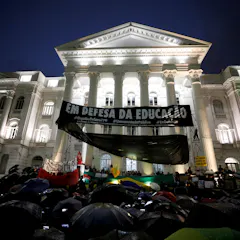
Brazil’s new president was elected on promises to radically restructure Brazil. But proposed education spending cuts and curricular changes have students and teachers marching in the streets.

Nigeria has the world’s highest number of out-of-school children and over 60 million of its citizens are illiterate. Here’s what the country can do to improve its education sector.

Increased funding to Catholic schools won’t necessarily make them more accessible for low-income families.

New analysis shows wealthy parents at advantaged Catholic primary schools could actually afford the increase to school fees under the needs-based model.
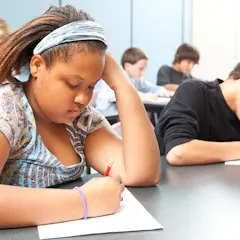
A state court has ruled that New Mexico is not doing enough to ensure its students receive an adequate education. Other states should be held accountable in the same way, an education scholar argues.
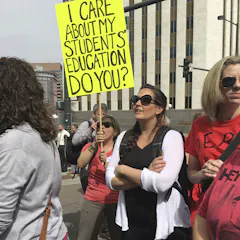
Traditional public schools suffer as states create favorable funding schemes for charter schools and school vouchers.

The year 2017 is finally coming to an end, so here’s a wrap of our coverage for the year, with bonus quiz!

In some places, the dismal labour conditions of young academics have spurred them to unionise. Not so in the Czech Republic, where students and intellectuals lead lives of “state-ordered poverty”.

Many of the programs being cut in the Trump-DeVos education budget serve low-income families – families that aren’t likely to benefit from the budget’s reallocation of funds toward school choice.
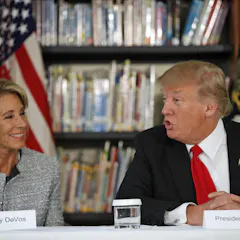
The Trump administration’s new education budget cuts money from traditional schools and funnels it toward school choice. Is it a nail in the coffin for public education?

The government is right to cut back on funding certain VET courses that have low-enrolment rates and are unlikely to lead to work.
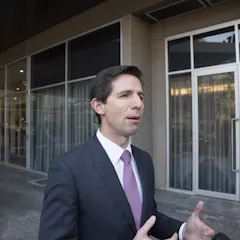
A new school funding model being proposed aims to free up funds to help education ministers resolve their differences in state funding, and deliver needs-based funding in full.
The claim that school spending has increased is misleading and simplistic.
The Productivity Commission has said that education spending has substantially increased over the last decade but student achievement has shown little or no improvement. Is that true?
Claims made by politicians and the media about what does and does not improve education outcomes are repeated on a regular basis. But is there much truth in them?

Focusing on progress – not just achievement – and investing in improving teaching practice will help to lift slipping standards in Australian schools.

So far the budget has given us more education gift cards to use in the stores of the federal government’s choosing - two more tests for children; one when they come into school and one when they leave.

The children most likely to benefit from quality early education are the most likely to miss out. Here are five key changes the government needs to make to address this.
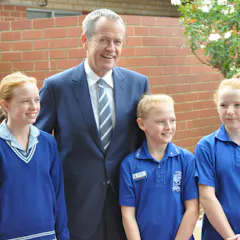
Bill Shorten on Wednesday will launch a campaign to exploit Malcolm Turnbull’s suggestion that it would be logical for state governments to take over full funding responsibility for public schools.
Top contributors
-

School Education Program Director, Grattan Institute
-
Professor of Law, University of South Carolina
-
Associate Professor in Education, Deakin University
-
Professorial Fellow, University of Canberra
-
Senior Research Scientist, African Population and Health Research Center
-
Adjunct associate professor, Southern Cross University
-
Professor emeritus, School of Education and School of Social and Political Sciences, University of Edinburgh
-
Dean of the College of Community and Public Affairs, Binghamton University, State University of New York
-
Professor of Culture and Communication, University of Leicester
-
Dean of Education, School of Education and Institute for Education, Bath Spa University
-
Vice-Chancellor, The University of Queensland
-
Associate Professor in Language, Literacy and TESL, University of Canberra
-
Vice-Chancellor, Te Kunenga ki Pūrehuroa – Massey University
-
Director of Research and Development, Pivot Professional Learning; and Honorary Fellow, The University of Melbourne
-
Emeritus professor, The University of Western Australia