
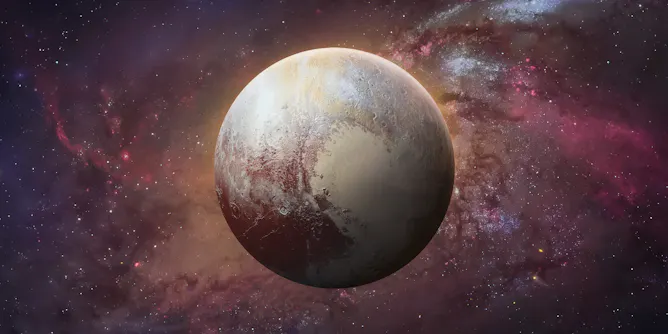
A South African team had a rare chance to capture information about Pluto’s atmosphere.
Articles on Dwarf planets
Displaying all articles

The Solar System could be awash with oceans, not on the surface but hidden inside the most surprising bodies
A curious kid asks: Why does it matter if Pluto is a planet or a dwarf planet?

The dwarf planets in our Solar System are cold, dark, far away and full of surprises.

Pluto began hot inside, study of its surface fractures suggests

The dwarf planet Pluto is heading away from the Sun and that’s having a devastating impact on its atmosphere.

There’s a mysterious lack of small bodies beyond Neptune, but a ‘snowman-shaped’ object may help explain why.

Whether you call it Planet X or Planet Nine, talk of another planet lurking in our Solar system won’t go away. So what does the discovery of a new object – nicknamed “The Goblin” – add to the debate?

Pluto has a density between that of rock and ice – so that immediately suggests the dwarf planet is made of a mix of both. But how do we know?
Discovery of many icy worlds helps unravel the solar system’s history.

It turns out that a common physical process called diffusion can explain the orbits of faraway minor planets – no need for a Planet Nine.
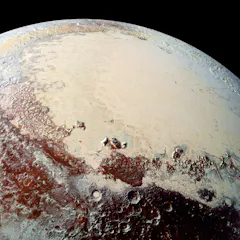
A group of astronomers are trying to reclassify Pluto as full ‘planet’. But there are good reasons to leave our classification system alone, and this doesn’t mean Pluto is any less interesting.
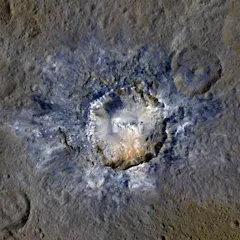
The latest data from the Dawn space probe points to underground ice flows and a water vapour atmosphere.

Dawn’s mission director and chief engineer describes his ‘dream come true’ job – and how the new data coming back from Ceres could unlock some of the secrets of the earliest days of our solar system.
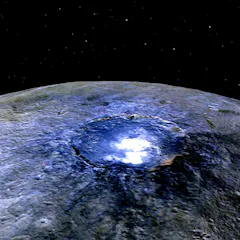
Is it a dwarf planet, an asteroid or a comet? All of the above? Well, with the latest results about Ceres, researchers aren’t entirely sure anymore.
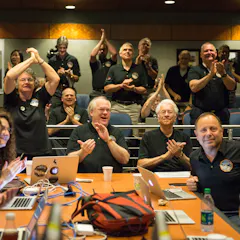
New Horizons mission members have worked on the project for even longer than it’s taken the spacecraft to get to Pluto. They’ve planned, built and researched – and now their efforts are paying off.
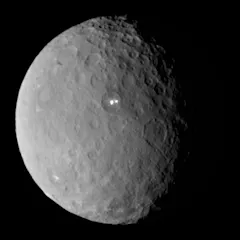
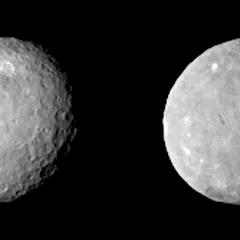
NASA’s Dawn spacecraft hasn’t reached optimum orbit around Ceres but the data it’s returning has already got scientists excited.
With increasing knowledge and familiarity, we’ll no longer be able to identify meaningful criteria to keep these good planets down.
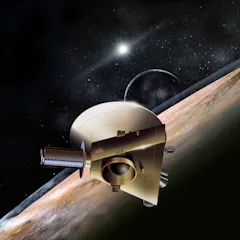
While the Mars Rovers and the Rosetta spacecraft will continue to make headlines in 2015, the stage is set for the solar system’s next great mission – the Pluto-bound New Horizons. Discovered in 1930…
A dwarf planet first seen in 2007 has been found to have a surface half-covered in water ice that once flowed from ancient…
Top contributors
-

Professor of Planetary Geosciences, The Open University
-
Professor of Planetary and Space Sciences, The Open University
-
Professor (Astrophysics), University of Southern Queensland
-
Associate Professor in Planetary Astronomy, University of Canterbury
-
PhD Candidate, University of Southern Queensland
-
Professor of Planetary Science and Astronomy, George Mason University
-
Associate Professor in Astrophysics, University of Tasmania
-
Professor of Physics and Astronomy, USC Dornsife College of Letters, Arts and Sciences
-
Associate Professor, Astronomy, University of Regina
-
Senior Curator (Astronomy), Museums Victoria Research Institute; The University of Melbourne
-
Full Professor of Physics, University of the Western Cape
-
Dawn Chief Engineer and Mission Director at JPL, NASA
-
Professor of Astronomy, Vanderbilt University
-
Senior Instrument Scientist, Australian Nuclear Science and Technology Organisation