

Rural places have long built and expanded prisons to tap federal funds during hard times.
Articles on Deportation
Displaying 1 - 20 of 88 articles

In a knee-jerk reaction to the situation in Ceuta, 22 EU member states are seeking to step up border security. What are the legal loopholes and do stronger controls comply with the rule of law?

The children and young people involved in the research were clear on what would help them most.
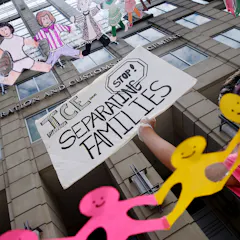
Limits on healthcare for undocumented women are reshaping pregnancy and family health.
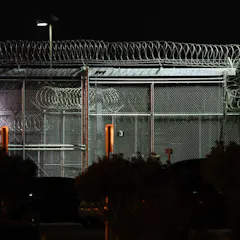
Scholars have defined the elements of what qualifies as a concentration camp system. Based on those, ICE detention facilities meet the definition of concentration camps.

For body cameras to function as transparency tools, wrongdoing would have to be consistently penalized, highlighting the consequences of noncompliance.
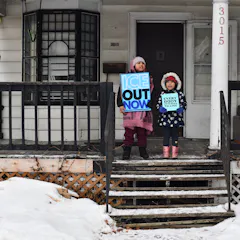
Children with a parent or family member who is detained, or are part of a drawn-out immigration court case, are twice as likely to have anxiety as young adults.

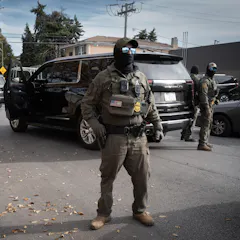
Militarized immigration enforcement used to be confined to near the US-Mexico border, far away from most Americans’ front lawns.
District courts have dismissed the administration’s efforts to detain virtually all undocumented immigrants without a bond hearing while they await deportation proceedings.

Americans have looked to the Declaration of Independence when they sought to remedy contemporary problems and create new visions for the country’s future.

Climate change is already linked to mass deportation – and the worst is still to come.

A migration researcher based in Denmark explains the downsides of its “zero asylum” policy and returns system.
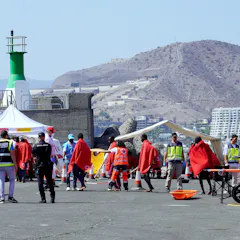
The border agents we interviewed objected to detaining and forcibly returning irregular migrants.
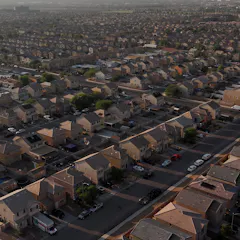
Anti-immigrant housing policies have been cast as a way for citizens to access more housing, but they fail to prevent the shortages driving the crises.
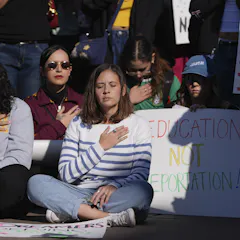
While some students living in the US without legal authorization can apply for private scholarships or state-based financial aid, a growing number of states are changing the rules.
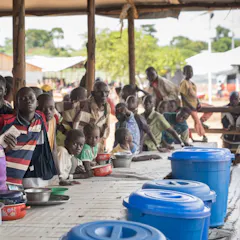
The US is not alone in its attempts to send asylum seekers to countries in Africa.

You’re probably hearing references in the news to “Article 1,” “Article 2” and “Article 3.” Why are phrases usually associated with discussions of constitutional law now cropping up in politics?

The meaning and application of due process has become a crucial issue in the US, most often with respect to the Trump administration’s migrant deportation efforts.

Neither President Donald Trump nor Florida Gov. Ron DeSantis can legally create a new system of immigration judges outside of the one established by Congress.

A 1952 law that President Harry S. Truman opposed, calling it a step backward, now underpins many actions by the Trump administration against noncitizens in the US.
Top contributors
-

Professor of Political Science, University of Oregon
-
Clinical Associate Professor of Law, Co-Director, USC Immigration Clinic, University of Southern California
-
President, Dickinson College
-
Professor of International Politics, Lancaster University
-
Dean of Law, Australian Catholic University
-
Senior researcher, Arnold Bergstraesser Institute
-
Senior Lecturer in Human Rights, Constitutional Law and Legal Theory, University of Wollongong
-
Reader in Sociology, City St George's, University of London
-
Assistant Professor of Human Rights and Cultural Relations, American University School of International Service
-
Deputy Director, Global Migration Center, University of California, Davis
-
Associate Professor of Political Science, University of New Mexico
-
Associate Professor of English, University of California, Irvine
-
Samuel Weiss Faculty Scholar and Founding Director, Center for Immigrants' Rights Clinic, Penn State
-
Professor, Melbourne Law School, The University of Melbourne
-
Clinical Professor, School of Law, Boston University