

Those who are leaving the platform represent a small, but by no means insignificant, counter current to the norm.
Articles on Cambridge Analytica
Displaying 21 - 40 of 93 articles

Most of us are probably having our data tracked in some form. And while there are regulatory safeguards in place to protect user privacy, it’s hard to say whether these are enough.

New technologies and user-level data mean that wealthy companies can influence our politics in ways not open to ordinary people.

The Canadian prime minister is the latest public figure struggling to apologize for past misbehavior. A language scholar explains how to do it right.

Data analytics have played a role in elections for years. But today’s massive voter relationship management platforms use digital campaigning practices to take it to another level.

Companies scrutinise our online likes, dislikes, searches and purchases to produce data that can be used commercially. And it’s often done without us understanding the full extent of the surveillance.

The UK Online Harms White Paper outlines possible internet regulation measures, and Canada would do well to study its approach.

In the face of digital disruption that threatens the very fabric of democratic culture we must refashion Enlightenment oppositions for new times.
Social media manipulation is tearing societies apart – but it can help put us back together again.
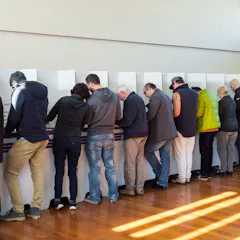
After the 2016 US election and ensuing Cambridge Analytic scandal, there was a lot of scaremongering around digital election campaigning. But this hysteria is, for the most part, unfounded.

The European Union has enacted a systematic plan to give people more control over their personal data online. But despite these efforts, privacy agreements remain largely unreadable.

The end of the era of self-regulation for big tech companies is nigh.

Trying to figure out if Virginia Gov. Ralph Northam or other would-be penitents are sincere? A scholar who analyzed dozens of recent apologies offers a user’s guide.
Some Australian Facebook users are more worried about over-sharing by friends than the privacy and security of their personal information.

For those who still consider memes like the #10yearchallenge as harmless and innocent information sharing perhaps it’s time to reconsider.

Regulation of the internet is inevitable and governments, rather than businesses, should seek to regulate it.

The issues that captured the world’s attention this year show the struggle to secure human rights is far from over.

The enthusiasm for business creation is not without negative consequences, especially for the many who fail. However, the “all entrepreneurs” discourse remains predominant.

On May 25, 2018, the EU’s General Data Protection Regulation (GDPR) came into force. Four months later, how has the law changed people’s perceptions and behaviour?

The social network is stopping researchers accessing its data – with significant consequences.
Top contributors
-

Professor and Canada Research Chair in Communication Policy and Governance, McMaster University
-
Associate Professor of English Language Studies, The Middlebury Institute of International Studies at Monterey, Middlebury College
-
Research, University of Bath
-
Associate Professor, Faculty of Law & Justice; Lead, UNSW Public Interest Law & Tech Initiative, UNSW
-
Professeur, École des médias, Université du Québec à Montréal (UQAM)
-
Associate Professor of Political Science, Brock University
-
Doctoral student , Concordia University
-
Director of the Conrad School of Entrepreneurship and Business, University of Waterloo
-
Associate Professor and Leader of the VOSON Lab, School of Sociology, Australian National University
-
Professor of Marketing, University of Sydney
-
Postdoctoral Research Fellow, University of Toronto, University of Toronto
-
Senior Lecturer, Public Law, University of Aberdeen
-
Professor of Comparative Politics, University of Warwick
-
Executive Director, Arizona State University
-
Former data protection and surveillance stream lead, Allens Hub for Technology, Law and Innovation, UNSW Law Faculty, UNSW