
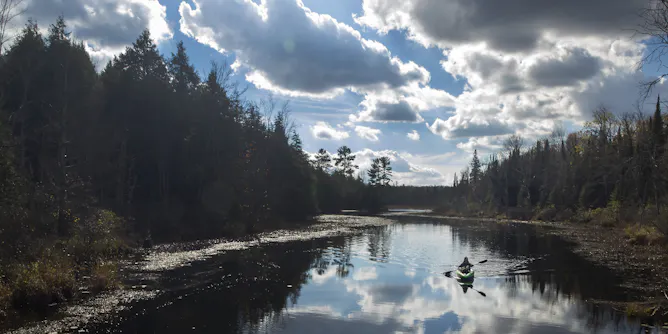
Accelerated resource development in Canada should not burden future generations with environmental destruction.
Articles on Boreal forests
Displaying all articles
Satellites used satellite sensors to identify the 0.01% ‘most extreme’ fires worldwide.
Research shows that the distribution of temperate hardwoods (sugar maple, red maple and yellow birch) could be shifting northward, which would have serious consequences for the boreal forest.

How will Earth’s vast boreal forests look in a warmer world? Combining satellite-based research with fieldwork shows that the planet’s largest wilderness may be changing in unexpected ways.
A better understanding of the interactions between the boreal forest and snow will make it possible to improve hydrological models and ensure optimal management of the resource.
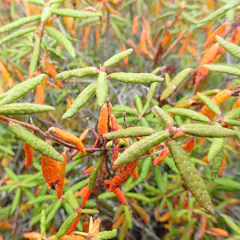
Some boreal plant species are classified — and treated — as weeds, affecting Indigenous communities’ access to important cultural, medicinal and ceremonial resources.
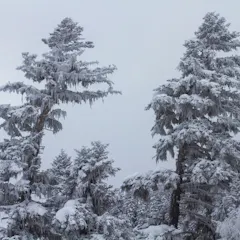
A longer growing season for trees, due to global warming, does not necessarily lead to an increase in wood production.

Human activities can affect plants and have consequences for the human populations that consume them.
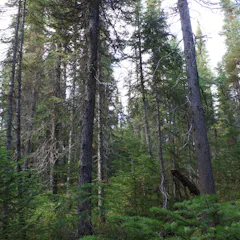
The remoteness and small size of old-growth boreal trees should not make us forget their high ecological importance and the many threats they face.
The rapidly changing climate presents many challenges for the sustainability of forest ecosystems. Assisting the migration of trees is a tool to address these challenges.
Top contributors
-

Professor, Département des Sciences Fondamentales, Université du Québec à Chicoutimi (UQAC)
-
Professeure, écologie végétale/Professor, plant ecology, Université du Québec en Abitibi-Témiscamingue (UQAT)
-
Agente de transfert de connaissances pour le Centre de recherche sur la boréalie (CREB), Université du Québec à Chicoutimi (UQAC)
-
Assistant Professor of Forest Ecology
-
Research professor, Université du Québec à Chicoutimi (UQAC)
-
Professeur en sciences forestière, Université du Québec en Abitibi-Témiscamingue (UQAT)
-
Associate Professor, Institute of Environmental Science and Department of Biology, Carleton University
-
Chercheuse scientifique et professeure associée, Université du Québec à Chicoutimi (UQAC)
-
Senior Research Scientist Emeritus, Colorado State University
-
Écologie et aménagement forestiers, Université du Québec en Abitibi-Témiscamingue (UQAT)
-
PhD student in Forest Ecophysiology, Université du Québec à Chicoutimi (UQAC)
-
Doctorant en écologie forestière, Université du Québec en Abitibi-Témiscamingue (UQAT)
-
Doctorant en sciences de l'environnement, Université du Québec en Abitibi-Témiscamingue (UQAT)
-
Assistant Professor of Conservation Science, Carleton University
-
Associate professor, Anthropology, Athabasca University