
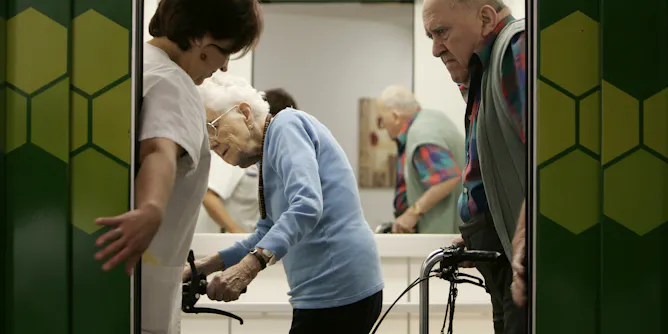
Nursing home providers looking to cut costs are bypassing registered nurses and employing less-skilled personal care attendants (PCAs) who aren’t trained for the job.
Articles on Aged care reform
Displaying 21 - 31 of 31 articles
Often the same centres in need of more care workers are those with high local unemployment.
Admitting a loved one to a nursing home is a difficult decision and is usually only arrived at once the person’s care needs cannot be met by the family and community-based services.

More than half (52%) of aged care residents have symptoms of depression, compared with 10-15% of older people living in the community.

More than half of the Australian population believe they’re in very good to excellent health, have a high level of confidence in the health system and support the policy direction that the federal government’s…
As the baby boomers approach older age, the number of Australians aged over 65 is projected to rise from around 14% to 24% by 2056. Given that not even a massive influx of immigrants would reverse this…
Recent media reports have highlighted an anomaly in residential aged-care funding in Australia: that day-to-day operations of facilities are governed by both Commonwealth and state government policies…
Cancer rates of people over the age of 65 is due to triple by 2040, according to researchers in the United Kingdom. A study…
Life expectancy in [Australia](http://www.abs.gov.au/AUSSTATS/abs@.nsf/Lookup/4102.0Main+Features10Mar+2011](http://www.abs.gov.au/AUSSTATS/abs@.nsf/Lookup/4102.0Main+Features10Mar+2011) is at an all-time…

Much of the budget analysis over the past week has concentrated on the shuffling of expenditure for 2012-13 back to this financial year in order to achieve a surplus. It’s true that $17.6bn of such transfers…
The Government’s aged care reforms are a landmark for setting valuable directions for better care. It’s the first such major initiative in more than 25 years – but there’s a long and uncertain road ahead…
Top contributors
-

Professorial Fellow, University of Canberra
-
Director of IMPACCT, Professor of Palliative Nursing, University of Technology Sydney
-
Associate Professor of Accounting, University of Technology Sydney
-
Honorary Enterprise Professor, School of Population and Global Health, and Department of General Practice and Primary Care, The University of Melbourne
-
Professor of Nursing Aged Care (Dementia), University of Technology Sydney
-
Professor and Director, Macquarie University Centre for the Health Economy, Macquarie University
-
Professor of Nursing, University of Sydney; University of Technology Sydney
-
Principal Researcher, Research Matters; Research Officer, Monash University
-
Honorary associate professor of economy and society, Macquarie University
-
Professor of Clinical Psychology, Swinburne University of Technology
-
Associate Professor, Older Persons' Health Care, School of Nursing & Midwifery, Curtin University
-
Associate Professor, Monash University
-
Emeritus Professor, The University of Melbourne
-
Researcher, College of Business, RMIT University
-
Professor of Health Economics, University of Technology Sydney