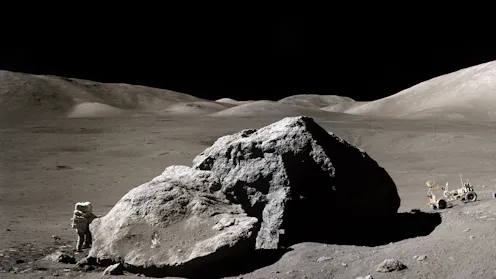
To sustainably survive on the Moon, the rock that stretches as far as the eye can see across its surface might well be able to provide us with the air we need to breathe.
Eugene A. Cernan/NASA
Jack Robinot, Centre national de la recherche scientifique (CNRS); Université de Perpignan Via Domitia; Alexis Paillet, Centre national d’études spatiales (CNES); Stéphane Abanades, Centre national de la recherche scientifique (CNRS), and Sylvain Rodat, Centre national de la recherche scientifique (CNRS)
As lunar missions are back in vogue with engineering more sustainable human presence on the Moon in mind, there’s no getting away from the fact that you can’t breathe on a satellite that has no atmosphere.
Pour survivre à long terme sur la Lune, la roche qui s’étend à perte de vue à sa surface pourrait bien nous fournir de quoi y respirer.
Eugene A. Cernan/NASA
Jack Robinot, Centre national de la recherche scientifique (CNRS); Université de Perpignan Via Domitia; Alexis Paillet, Centre national d’études spatiales (CNES); Stéphane Abanades, Centre national de la recherche scientifique (CNRS), and Sylvain Rodat, Centre national de la recherche scientifique (CNRS)
Alors que les projets de retour sur la Lune se multiplient, et cette fois-ci pour s’y implanter durablement, comment respirer sur un astre sans atmosphère ?