
• Home

Edition

Skip to content
The Conversation
Edition:
  • Africa
  • Australia
  • Brasil
  • Canada
  • Canada (français)
  • Català
  • España
  • France
  • Global
  • Indonesia
  • New Zealand
  • United Kingdom
  • United States
s
Newsletters
The Conversation
Academic rigour, journalistic flair

Robert Hoffmann

22

Articles

1

Comment
  • Professor of Economics, Tasmanian Behavioural Lab, University of Tasmania

Profile Articles
Julia M Cameron/Pexels
August 18, 2025

Soft plastics recycling looks set to return to supermarkets. Cutting back on plastic would be even better

Louise Grimmer, University of Tasmania; Robert Hoffmann, University of Tasmania, and Swee-Hoon Chuah, University of Tasmania

How will the new recycling scheme involving Woolworths, Coles and Aldi work? And what are some upsides for shoppers if we had more plastic-free food to choose from?
Diego Fedele/AAP
August 5, 2025

After years of backsliding, the ADF is growing again. What’s behind the recruitment uptick?

Robert Hoffmann, University of Tasmania

After years of warnings of a recruitment crisis in defence, new data show its suddenly risen by 17%. There’s a combination of reasons why.

Shutterstock
January 1, 2025

Why your spin bike has become a clothes rack – and what you can do about it, according to behavioural science

Swee-Hoon Chuah, University of Tasmania and Robert Hoffmann, University of Tasmania

Planning health and fitness goals for 2025? Here’s how to make home exercise equipment work for you (and keep it from becoming useless household clutter).

Shutterstock
October 7, 2024

People don’t like a ‘white saviour’, but does it affect how they donate to charity?

Robert Hoffmann, University of Tasmania; Ananta Neelim, University of Tasmania; Simon Feeny, RMIT University, and Swee-Hoon Chuah, University of Tasmania

White people that sweep into developing countries to “save” people of colour are widely derided, including by donors. Does this translate to less charity donations?

Darren England/AAP
June 9, 2024

Gen Z is turning away from military service in record numbers. We’re trying to understand why

Robert Hoffmann, University of Tasmania and Maria Teresa Beamond, RMIT University

The Australian Defence Force is in desperate need of more recruits. How could they get more Gen Z people on board?

Shutterstock
September 7, 2023

Red tape can strangle your key asset as an employee: your motivation

Meg Elkins, RMIT University; Ananta Neelim, University of Tasmania, and Robert Hoffmann, University of Tasmania

Management jobs are proliferating much faster than other roles. But behavioural research shows the extra box-ticking can leave employees feeling stressed, patronised and demotivated.

Mast Irham/EPA
July 17, 2023

Recruiting for the modern military: new research examines why people choose to serve and who makes the ideal soldier

Robert Hoffmann, University of Tasmania; Lena Wang, RMIT University, and Maria Teresa Beamond, RMIT University

Understanding people’s motivations for enlisting can also reveal a lot about the suitability of recruits for the military, given the new demands they face in these roles.

Shutterstock
December 25, 2022

Are nudges sinister psychological tricks? Or are they useless? Actually they are neither

Meg Elkins, RMIT University; Robert Hoffmann, University of Tasmania, and Swee-Hoon Chuah, University of Tasmania

The merits of ‘nudging’ have become. entangled in the ideological war over pandemic responses.

One of these vases was painted by a woman; the other by a man. Can you guess which is which? B van der Ast/M van Oosterwijck
September 5, 2022

Male artists dominate galleries. Our research explored if it’s because ‘women don’t paint very well’ – or just discrimination

Robert Hoffmann, RMIT University and Bronwyn Coate, RMIT University

People in our experiments liked art by women – but believed women’s paintings are less attractive for investment.

Shutterstock
August 19, 2022

Inflationary psychology could make things worse, but for now it’s in check

Meg Elkins, RMIT University and Robert Hoffmann, RMIT University

So far, we are not getting carried away about inflation.

Netflix.
April 6, 2022

Daya tarik Inventing Anna terletak pada betapa mudahnya pelaku menipu kita

Meg Elkins, RMIT University and Robert Hoffmann, RMIT University

“Itu tidak mungkin terjadi pada saya”: mengapa kami pikir kami kebal terhadap penipuan penipu, bagaimana mereka menipu orang biasa - dan mengapa kami menyukai pertunjukan tentang mereka.

Netflix
February 24, 2022

We’re obsessed with shows about con artists like Inventing Anna: the fascination lies in how easily these people can dupe us

Meg Elkins, RMIT University and Robert Hoffmann, RMIT University

“It can’t happen to me”: why we think we’re immune to con artist scams, how they go about swindling regular people - and why we love shows about them.

shutterstock.
August 15, 2021

Why lotteries, doughnuts and beer aren’t the right vaccination ‘nudges’

Meg Elkins, RMIT University; Robert Hoffmann, RMIT University, and Swee-Hoon Chuah, University of Tasmania

Too much of our discussion about vaccine hesitancy imagines the problem in rational terms. Perceptions about COVID-19 and vaccines are driven by emotion, not reason.

Couperfield/Shutterstock
June 29, 2021

From UFOs to COVID conspiracy theories, we all struggle with the ‘truth out there’

Meg Elkins, RMIT University and Robert Hoffmann, RMIT University

The difference between conspiratorial thinking and believing the official narrative isn’t necessarily as big as you might you think.

Shutterstock
January 10, 2021

The commuter’s paradox: there’s something to gain in the space between home and work

Meg Elkins, RMIT University and Robert Hoffmann, RMIT University

Most of us dislike commuting. But there are ways to make it a more positive experience.

Dean Lewins/AAP
January 10, 2021

Even with a vaccine, we need to adjust our mindset to playing the COVID‑19 long game

Robert Hoffmann, RMIT University and Swee-Hoon Chuah, University of Tasmania

With many more months of lockdowns, mask mandates and quarantining in our futures, the government needs to get its messaging just right and we all need to manage our expectations appropriately.

Police move anti-lockdown protesters on at Melbourne’s Queen Victoria Market on Sunday, September 13 2020. Erik Anderson/AAP
October 19, 2020

Beyond the police state to COVID‑safe: life after lockdown will need a novel approach

Meg Elkins, RMIT University and Robert Hoffmann, RMIT University

Law enforcement is a blunt tool to achieve social conformity with COVID-safe rule. It’s time to start thinking about other strategies to promote new norms.
Wes Mountain/The Conversation
August 11, 2020

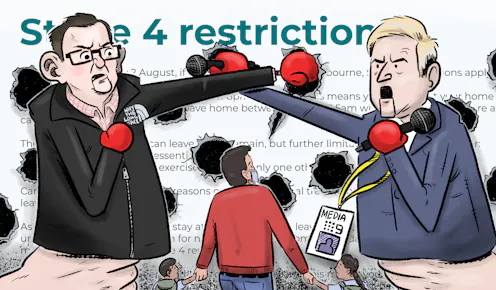
Playing the COVID‑19 blame game may feel good, but it could come at a cost — the government’s credibility

Robert Hoffmann, RMIT University; Ananta Neelim, RMIT University; Meg Elkins, RMIT University, and Peyman Khezr, RMIT University

The government has become an easy scapegoat as the pandemic has worsened. While blame can alleviate stress, grief and guilt, it can also be counterproductive if people trust less in their leaders.

Jeremy Hogan / SOPA Images/Sipa USA
July 30, 2020

What to do with anti‑maskers? Punishment has its place, but can also entrench resistance

Meg Elkins, RMIT University and Robert Hoffmann, RMIT University

Our desire to condemn and punish non-cooperative behaviour is strong. But we must also try to understand the complex emotional motivations of those refusing to wear masks.

Behavioural economics is turning traditional notions of risk on their head. EPA/AAP
October 9, 2017

Explainer: how our understanding of risk is changing

Robert Hoffmann, RMIT University and Adrian R. Camilleri, RMIT University

People aren’t the perfectly rational, number-crunching risk-takers that traditional theory suggests. Research shows a whole variety of factors feed into risk-taking.

The research found a belief in hard work and enterprise drives the business success of Chinese living overseas. www.shutterstock.com
February 2, 2017

Hard work, not ‘Confucian’ mentality, underpins Chinese success overseas

Robert Hoffmann, RMIT University and Swee-Hoon Chuah, RMIT University

Past studies point to traditional Confucian values and a refugee mentality as a reason for the business success of Chinese people living overseas, our research debunks this.

Renowned economist Thomas Schelling celebrates winning the 2005 Nobel Prize in Economics. Mike Theiler/AAP
December 14, 2016

Thomas Schelling: the legacy of a master strategist

Robert Hoffmann, RMIT University

Nobel Prize winner Thomas Schelling will be recognised for his little-known comments that sparked behavioural economics.
  • Location: Hobart, Australia
  • Website
  • Article Feed
  • ORCID
  • Joined January 11, 2016
Institution logo of University of Tasmania
  • Editorial Policies
  • Community standards
  • Republishing guidelines
  • Analytics
  • Our feeds
  • Get newsletter
  • Who we are
  • Our charter
  • Partners and funders
  • Resource for media
  • Contact us
Privacy policy Consent preferences Terms and conditions Corrections

Copyright © 2010–2026, The Conversation Media Group Ltd