Antonio Tarquinio, The Conversation and Sunanda Creagh, The Conversation
We asked astronomers: are we alone in the Universe? The answer was surprisingly consistent
The Conversation33.5 MB(download)
'I think that we will discover life outside of Earth in my lifetime. If not that, then in your lifetime,' one astronomer told us.
Today we hear about some of the fascinating space research underway at Siding Spring Observatory – and how, despite gruelling hours and endless paperwork, astronomers retain their sense of wonder for the night sky.
Shutterstock
Cameron Furlong, The Conversation and Sunanda Creagh, The Conversation
‘The size, the grandeur, the peacefulness of being in the dark’: what it’s like to study space at Siding Spring Observatory
The Conversation, CC BY54.3 MB(download)
Three hours north-east of Parkes lies a remote astronomical research facility, unpolluted by city lights, where researchers are trying to unlock some of the biggest questions about our Universe.
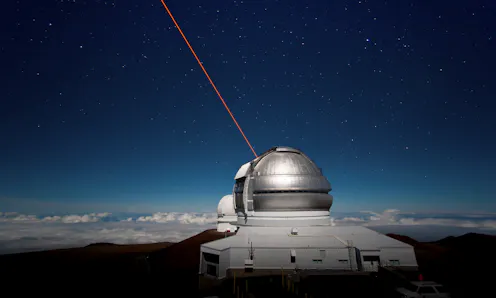
Gemini North observatory, on Hawaii’s Mauna Kea, shoots a laser beam into the night sky to create an ‘artificial star’, part of a process that helps astronomers remove blurring from any images of galaxies.
Gemini Observatory and Association of Universities for Research in Astronomy
A supermassive black hole has been found in an ultracompact dwarf galaxy – the smallest galaxy known to contain such a massive black hole. This finding, published today in Nature, suggests that supermassive…