
Computers are increasingly used to prove mathematical theorems. So does that mean human mathematicians will become obselete?
- Laureate Professor of Mathematics, University of Newcastle
On international Pi Day it’s time to look at Pi’s position in unique formula that’s praised much for its beauty in uniting several mathematical constants.

Srinivasa Ramanujan was one of the most brilliant mathematicians of the 20th century. His story is told in the movie The Man Who Knew Infinity, screening tonight in selected cinemas in Australia.
The rapid advancement of computing power has followed an unusual law that was first mooted a half century ago. But are there signs things could be slowing down?
Another retracted paper in the social sciences underscores the need for greater vigilance and reflection upon the causes of scientific fraud.
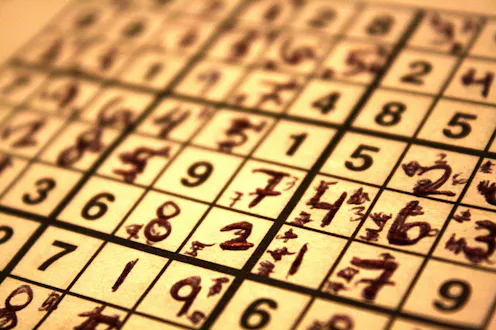
Have you heard the one about Cheryl’s birthday? It’s the latest puzzle that’s baffling people across the world.

A special Pi Day this year for those who celebrate this remarkable number on March 14, a date that can be written 3/14. Given 3.14 is Pi to two decimal places, what happens when you add in the year?

When numbers of any sort are presented in mathematics, science, business, government or finance, it’s fair to say a reader assumes that the data are reasonably reliable to their last digit. But presenting…

Australia’s iconic sporting event – the Melbourne Cup – will see more than 100,000 punters pack into Flemington Racecourse this Tuesday, while those at work around the country pause to tune in to The Race…

UNDERSTANDING RESEARCH: What do we actually mean by research and how does it help inform our understanding of things? Today we look at the dangers of making a link between unrelated results. Here’s an…
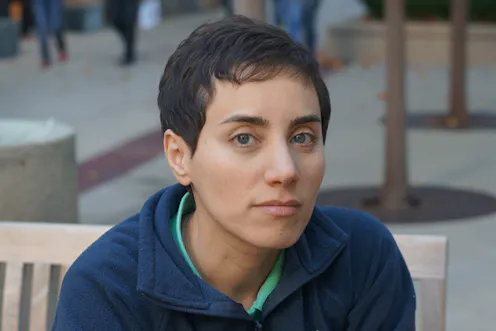
The four winners of the 2014 Fields medals – the most prestigious prizes for mathematics – were announced today, including the first female and first Latin American recipients of the 78-year-old…
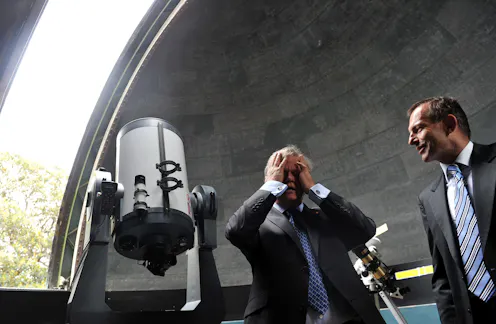
It’s hard to ignore the irony. The 2014 federal budget will “better target innovation and research funding to areas of national and strategic priority” but funding cuts of more than A$111 million to CSIRO…

When renowned scientists now talk seriously about millions of multiverses, the old question “are we alone?” gets a whole new meaning. Our ever-expanding universe is incomprehensibly large – and its…

The number pi (π = 3.14159265358979323846…), unique among the pantheon of mathematical constants, captures the fascination of the public and professional mathematicians. Three years ago one of the authors…

The warmth on your face, the scenic view outside – such delights are delivered to you by countless photons from the sun. But believe it or not, these photons move in much the same way as an inebriated…
Like many scientists, I was apprehensive in advance about the Abbott government’s approach to science policy. Would it be pragmatic but fact-based or would it be ideological and politically driven? Sadly…

Perhaps the only positive note that can be sounded on the Australian science literacy survey results, released on Wednesday by the Australian Academy of Science (AAS), is they are somewhat better than…

In recent weeks, two truly major results have been announced in the realm of (analytic) number theory, namely the mathematics of integers in general and of prime numbers in particular. Number theory, as…

The Australian government’s ironic and perverse decision to better fund schools at the expense of already-promised university funding would make for a good episode of the 1980s sitcom Yes, Prime Minister…

Fraud. It’s an ugly word, an arresting word. As with “cheating” it comes loaded with negative connotations, but can potentially lead to far greater penalties and consequences. And yet fraud in science…
Last week we learned a famous 2010 academic paper, relied on by political big-hitters to bolster arguments for austerity cuts, contained significant errors; and that those errors came down to misuse of…
So, the Higgs boson … Last week, researchers at the European Organization for Nuclear Research (CERN) finally announced the new particle discovered last summer is indeed a Higgs boson, a particle predicted…
We assess risk every day. But very few of us receive any formal training in the requisite mathematics and statistics, and, partly as a result, poor decisions are made, both by individuals and governmental…

In an announcement today, NASA poured cold water on rumours that its Curiosity rover had found life on Mars. Curiosity found evidence that it had landed on an ancient riverbed, and it identified some interesting…

Clouds are not spheres, mountains are not cones … Nature exhibits not simply a higher degree but an altogether different level of complexity. - Benoît Mandelbröt, The Fractal Geometry of Nature Chaos (n…
