• Adjunct Professor, Department of Applied Psychology and Human Development at Ontario Institute for the Study of Education (OISE) and Executive Director at the Atkinson Centre, University of Toronto
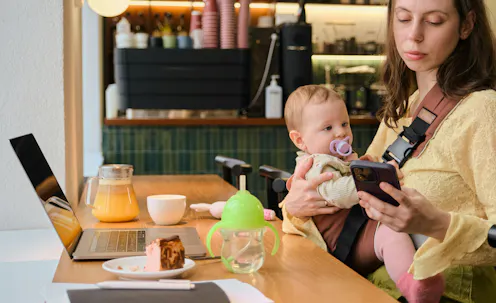
Lower child-care fees have helped increase employment among parents of young children in Canada while adding to the GDP, but there are access problems that policy could address. (Andrej Lisakov/Unsplash)

Have child, need job: How child‑care problems prevent many families from re‑entering the workforce

A new report shows Canada’s $10-a-day child care has generated real returns, but unlocking more benefits depends partly on bolstering the child-care workforce.
Ontario Premier Doug Ford speaks after reaching an agreement with the federal government in the $10-a-day child-care program deal in Brampton, Ont., in March 2022. THE CANADIAN PRESS/Nathan Denette

Staffing shortages risk Ontario’s $10‑a‑day child care

Ontario must seize the promise of Canada-wide early learning and child-care funding before it becomes another missed opportunity.

Palestinians inspect the rubble of a school destroyed in an Israeli airstrike on Deir al-Balah, central Gaza Strip, July 27, 2024. (AP Photo/Abdel Kareem Hana)

The lasting scars of war: How conflict shapes children’s lives long after the fighting ends

The impact of wars on children is vast and multifaceted. The trauma inflicted is enduring and will shape the rest of their lives — and by extension, the societies in which they and we live.
Affordability targets have been surpassed with $10-per-day child care the norm in much of the country, but depending on where you live, finding care can be onerous. Prime Minister Justin Trudeau visits a child-care centre in Dartmouth, N.S. on April 2, 2024. THE CANADIAN PRESS/Kelly Clark

Canada‑wide child care: It’s now less expensive, but finding it is more difficult

The Early Childhood Education Report offers detailed profiles capturing how each province and territory are doing with implementing Canada-wide early learning and child care.
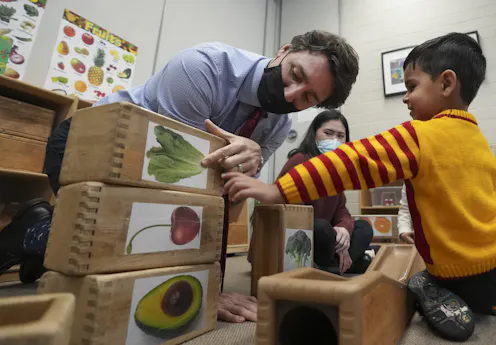
Le Premier ministre canadien Justin Trudeau, à gauche, joue avec des enfants dans un centre d'apprentissage et de garde d'enfants à Brampton, en Ontario, le 28 mars 2022. LA PRESSE CANADIENNE/Nathan Denette

Investissement fédéral de 27 milliards de dollars dans les services de garde : il faut penser vert

À l’heure actuelle, le lien entre l’éducation de la petite enfance et la durabilité nécessite beaucoup plus de financement, de bourses académiques et d’actions.
Canadian Prime Minister Justin Trudeau, left, plays with children in an early learning and child care centre in Brampton, Ont., March 28, 2022. THE CANADIAN PRESS/Nathan Denette

Canada’s child‑care investment needs to advance climate change policy goals

Where new early learning and child-care programs are located, how they are designed, built and resourced, and what they teach can either add to the problem of climate change or help mitigate it.
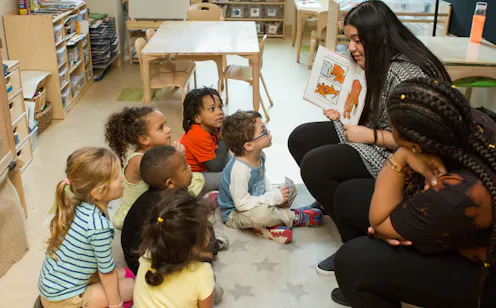
Almost as many trained early childhood educators work outside licensed child care as in it. Many say they would return to the field if offered decent work. (Allison Shelley/The Verbatim Agency for EDUimages)

Children across Canada deserve a professional early childhood education workforce

Staff recruitment and retention challenges aren’t seen in public child-care centres, where educators are paid substantially more, are unionized and have professional development opportunities.
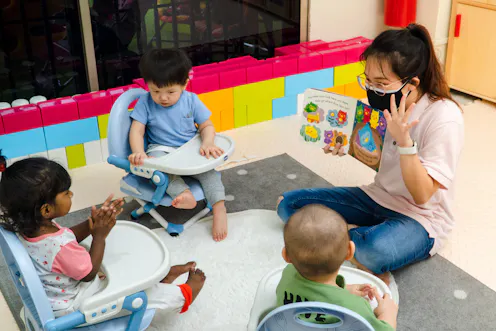
Ontario is creating far below the 200,000 to 300,000 early learning and care spaces needed to address the demand that will arise as parent fees decline. (Benson Low/Unsplash)

What Ontario parents really need to know about the new early learning and child care agreement

Among provinces, Ontario is the least generous supporter of its childhood educator workforce. Parents pay the price in available child-care spaces if a staffing recruitment crisis does not improve.

Canada’s failure to fulfil its commitments to the UN Sustainable Development Goals will leave our children worse off. THE CANADIAN PRESS/Nathan Denette

Canada’s woeful track record on children set to get worse with COVID‑19 pandemic

The COVID-19 pandemic risks making Canada’s already woeful record on child welfare worse. To safeguard a future for our children, governments must prioritize their care.

The interruption to young children’s learning is happening precisely at a time when developmental gains matter most. (Shutterstock)

Coronavirus school closures could widen inequities for our youngest students

Remote contact with families in the coronavirus emergency is critical, but learning on a screen is not how young children will gain the foundational and developmental skills they need.

Contact Emis for

  • General
  • Media request
  • Speaking request
  • Consulting / Advising
  • Research collaboration
  • Research supervision