

Research shows where those cost-of-living stresses are greatest. It’s not the vast bulk of middle income Australia, but working age welfare recipients.
- Associate Professor, POLIS@ANU Centre for Social Policy Research, Australian National University
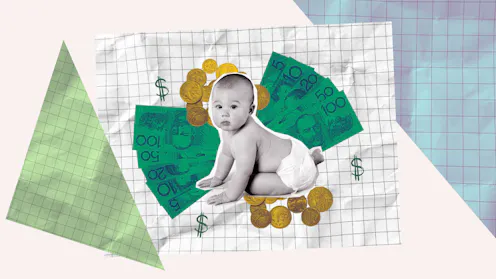
With fertility rates at a record low, many say young people aren’t having kids because they’re too expensive. Turns out, it’s not that simple.

New research finds most Australians keep more than 60% of what they earn from an extra day’s work. Very few lose more than 80 cents in the dollar.

Australia’s best-off and worst-off have improved their lots. The mortgaged middle has gone backwards.

An ANU economic model finds even among the highest earning households, the policy change produces more winners than losers.

The ACCC has published calculations for two children in care five days a week. More typical is one child in care two days a week. The typical cost is 5% of after-tax income, not 16%

Mortgaged households have faced a 17.5% increase in living costs over the past two years, compared to 10.8% for households who rent.

While the 2023-24 Budget’s welfare increases are welcome, they represent a less than 2% increase in the welfare budget each year.
ANU economist Ben Phillips, a member of the Economic Inclusion Advisory Committee, explains why it regards increasing JobSeeker as the most pressing priority for the Albanese government.

The tax cuts only look big when compared to no cuts, an alternative that isn’t realistic.

The big increases quoted are for “asking rents”. The rents paid by existing renters are climbing more slowly.

ANU modeling suggests 80% of households face living cost increases below the inflation rate of 6.1%.

The federal government introduced the current childcare subsidy and activity test in 2018. An evaluation of the policy has found it met some of its intended objectives but failed at others.

The most stressed are Australians on JobSeeker and single parents.

With cuts to JobKeeper and JobSeeker set to bite, Social Services Minister Anne Ruston has cast doubt over the idea of a poverty line.

Making some of the Newstart increase permanent would undo the worst of the damage.

A new mapping project shows where different types of disadvantage are most prevalent. The picture is more varied and complex than many people think.

Yes, most jobseekers who receive Newstart payments are also eligible for other benefits. But in many cases this is just a few dollars a fortnight to help with expenses such as electricity bills.

It’s the highest earning most wealthy shareowners who’ll be missing the cheques.

The promised tax cuts will benefit high earners in 2022 and 2024, but by then they’ll need it.

At times we are told Labor’s capital gains tax policy will hit mainly high earners. At other times, low earners. The truth, uncovered by our microsimulation model, tells us something about ourselves.

A new ANU computer algorithm can provide near instant answers about how to get the best bang for welfare dollars. It says we should boost Newstart and cut either pensions or family benefits.

Fixing Newstart isn’t enough. We need a comprehensive inquiry into our complex and bewildering social security system, especially as it applies to single parents.

Energy prices have doubled in ten years, but as a proportion of income, most of us are paying no more.

The income tax cuts in the 2018 federal budget are likely to be modestly regressive, giving high earners a lower share of the overall tax burden. But by 2028 income tax will be higher across the board.
Contact Ben for
- General
- Media request
- Speaking request
- Consulting / Advising
- Research collaboration
- Research supervision
- Location: Canberra, Australia
- X (formerly Twitter): @BenPhillips_ANU
- Article Feed
- Joined
