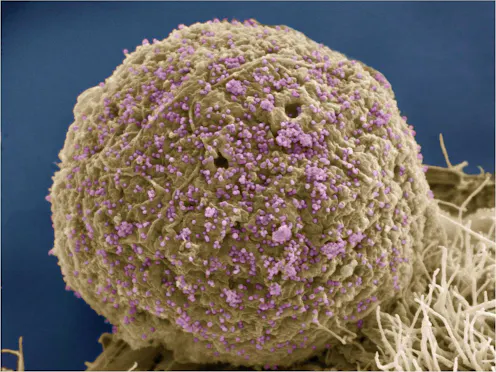
The human immunodeficiency virus (HIV), shown here as tiny purple spheres, causes the disease known as AIDS. Mark Ellisman and Tom Deerinck, National Center for Microscopy and Imaging Research

A cure for HIV? Feasible but not yet realized

Headlines around the world declared that a second person was cured of their HIV. But while the results are encouraging, we’re a long way from a cure.
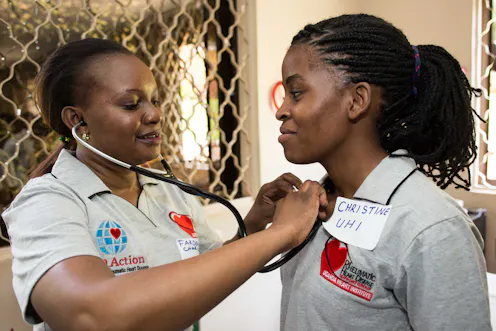
A nurse in Uganda uses a stethoscope to listen for heart problems at a screening and educational event Oct. 31, 2017. Tao Farren-Hefer

Women with heart disease in sub‑Saharan Africa face challenges, but stigma may be worst of all

Noncommunicable diseases are a growing problem in Africa. Among women, heart disease is a particular concern. Medication to treat it can interfere with pregnancy, making women undesirable partners.

In honor of National Women & Girls HIV/AIDS Awareness Day, Raheem DeVaughn sings to hundreds of women gathered at the launch of the national campaign on Wednesday, March 8, 2017, in Oakland, California. /Invision for AIDS Healthcare Foundation/AP Images/Peter Barreras

Living and aging well with HIV: New strategies and new research

HIV has no boundaries. Men and women in almost every country are affected. Yet strides have been made, so much so that many are able to think of living with AIDS rather than dying from it.

AIDS activists stage a ‘die-in’ in 1992 in Houston about lack of funding for AIDS research under President George H.W. Bush. Rick McFarland/AP

HIV/AIDS funding is an investment worth protecting

New treatments and prevention programs have inhibited the spread of HIV/AIDS since June 5, 1981, when the CDC first reported what would become HIV. Here’s why it’s important not to cut funding now.

Advances in HIV treatment have turned it into a chronic, but manageable, illness. In this photo: Artist Damien Hirst’s ‘Where there’s a will there’s a way,’ which shows antiretroviral drugs in a medicine cabinet, is seen as it is displayed at a gallery in New York, February 4 2008. Chip East/Reuters

How HIV became a treatable, chronic disease

Thanks to treatment advances, people with HIV can and do live long and full lives. And that has led to a challenge that doctors and patients may not have imagined 35 years ago: the aging HIV patient.

Contact Allison for

  • General
  • Media request
  • Speaking request
  • Consulting / Advising
  • Research collaboration
  • Research supervision