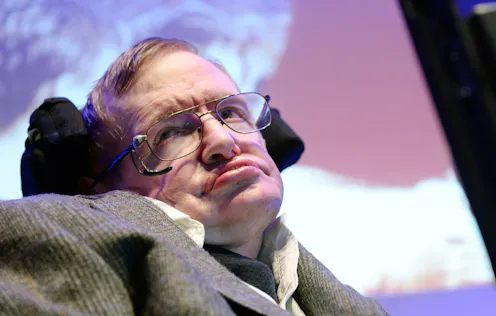
British theoretical physicist and cosmologist, Professor Stephen Hawking in 2014. EPA/Andy Rain

Tributes pour in for Stephen Hawking, the famous theoretical physicist who died at age 76

Stephen Hawking inspired people with his work on black holes and other mysteries of the universe. Many were quick to pay tribute to the theoretical physicist who died today in the UK, aged 76.
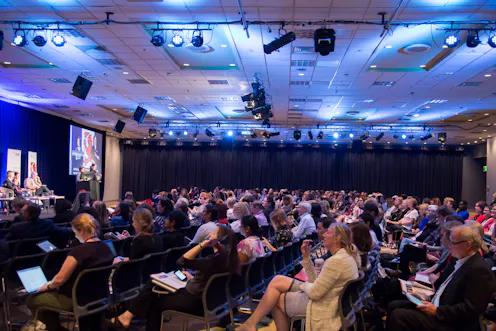
The SAGE Symposium in Brisbane this year brought together hundreds of interested parties across STEM to share and learn best practice in gender and diversity equity. Science in Australia Gender Equity (SAGE)

We are all of the same starstuff

To be a champion of science you must also be a champion of diversity in science.
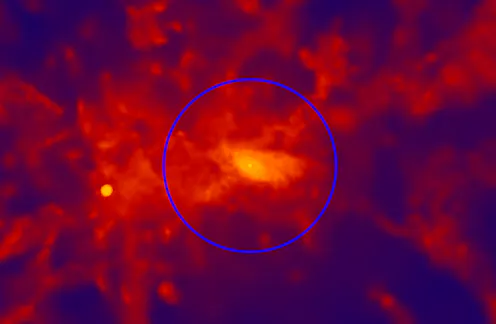
The density of gas in and around a simulated galaxy just over a billion years after the Big Bang. New gas is arriving at too great a rate for the galaxy to convert it into stars and the gas piles up. Alan Duffy/Swinburne University

The Great Galactic Recession

In the early Universe torrents of infalling gas outpace the ability of young galaxies to raise their demand of forming new stars to meet the supply, the result is a recession for the galactic economy.
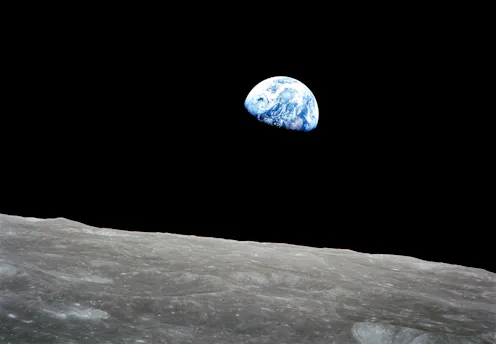
Science and technology have helped us picture that we all live together on a single world. NASA / Bill Anders

Step up for science at the crossroads for humanity

Our world faces enormous challenges that will only be solved by more science not less but scientists can’t do it alone.
The Stargazing Live promotional banner aims to get Australians looking up. After they’ve watched the show of course. ABC

Outreach ‑ why reach out?

Making science a ratings grab is a key part of reversing its declines in society and schools.
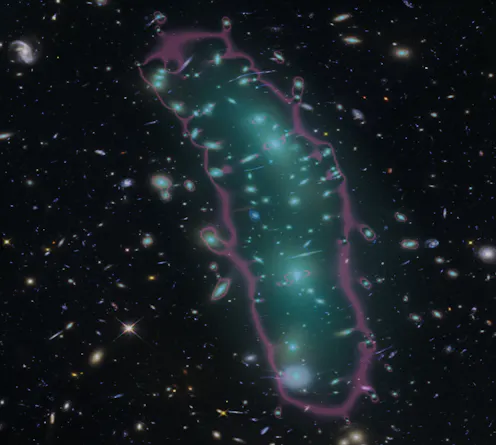
Galaxy cluster MACS 0416 bends light around it due to huge amounts of dark matter, indicated in cyan, acting as a magnifying lens for any background objects in the magenta regions. STScI/NASA/CATS Team/R. Livermore (UT Austin)

Baby galaxies light up the universe

Ingenious use of a naturally occurring cosmic magnifying glass suggests baby galaxies are a leading culprit for bringing light to our Universe’s darkest moment.
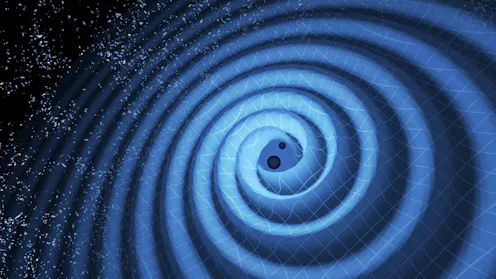
The discovery of the year was the first detection of gravitational waves. LIGO/T. Pyle

2016: the year in space and astronomy

Colliding black holes to exploding spacecraft, 2016 was an incredible year for astrophysics.
The annular solar eclipse of 4th January 2011 as seen by the Hinode satellite. The Moon is slightly more distant from Earth than in a total eclipse allowing a ring of sunlight to appear around the dark shadow of the Moon. NASA/Hinode/XRT

8 space reasons to look up in 2017

Meteor showers, eclipses, epic space missions and more, 2017 will be worth looking up for.
The gas giant Saturn revealed in all its splendour by NASA’s Cassini spacecraft. This vantage point revealed the hexagonal storm raging on the pole as well as the innermost rings surrounding the planet. NASA/JPL-Caltech/Space Science Institute

Thanksgiving space dinners, threading Saturn’s rings and impossible warp drives

Fuel-less rockets, Thanksgiving space-treats and threading an interplanetary needle, space never gets dull.
False colour image of Mercury taken by NASA’s MESSENGER spacecraft. Without a hot central core this should be a geologically dead world yet recent images suggest it’s still active. NASA/JHUAPL/Carnegie Institution of Washington/USGS/Arizona State University

Shrinking Mercury is all it’s cracked up to be

A tectonically active world means Mercury might share another feature with Earth, Mercury-quakes!
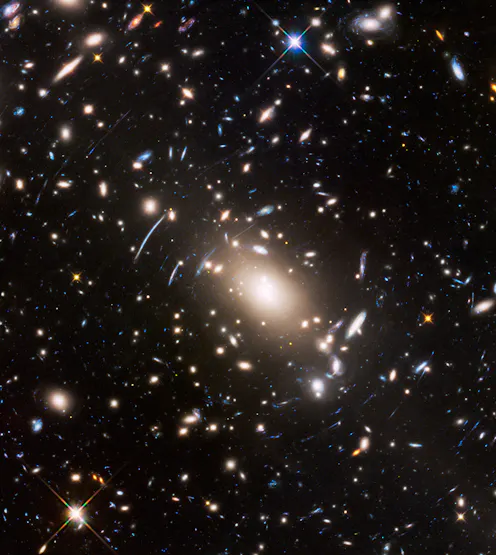
A Hubble Space Telescope image of the Frontier Field, an area of the sky containing the galaxy cluster Abell S1063. NASA / ESA and J. Lotz (STScl)

Hubble explores the Final Frontier

The Frontier Field seen by Hubble has a galaxy cluster which acts as a natural lens, magnifying even more distant galaxies into view from just several hundred million years after the Big Bang.
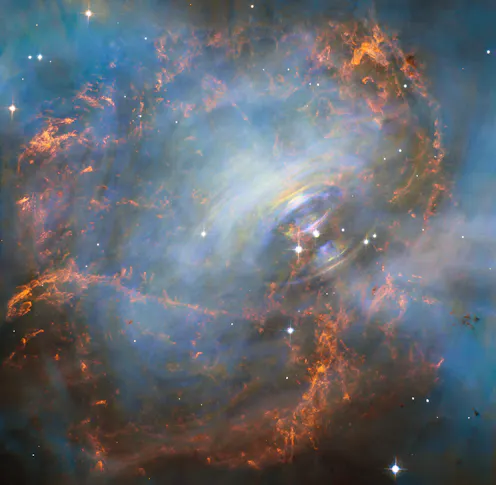
The core of the Crab Nebula reveals outflowing material, powered by the central neutron star. This is a timelapse of Hubble Space Telescope images taken each decade and coloured separately revealing the rainbow pattern as the fast moving material changes between frames. NASA / ESA

Beating heart of the Crab Nebula

The beautiful image from Hubble hides a monster at its heart, as rainbow-coloured winds are blown outwards by the tremendous energies of a neutron star.
The THAICOM 8 launch by SpaceX’s Falcon 9, successfully taking the telecommunications satellite into orbit and then landing the first stage on a barge at sea. SpaceX

Here’s what happened in space this week

From inflatable space stations to space sweeteners, it’s been an amazing week in space but none so visually astounding as the video from SpaceX of their 3rd successful landing at sea. Three perfect landings…
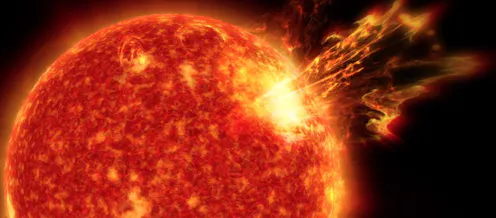
Image from NASA of an outburst from the Sun, these were more common when our star was younger. They may have both lead to a warmer Earth as well as the building blocks for life itself. NASA

Huge solar storms may be key to life on Earth

The latest results from NASA’s Kepler satellite may have finally solved the mystery of how the conditions for life were created on our younger Earth - and surprisingly it seems titanic eruptions from the…
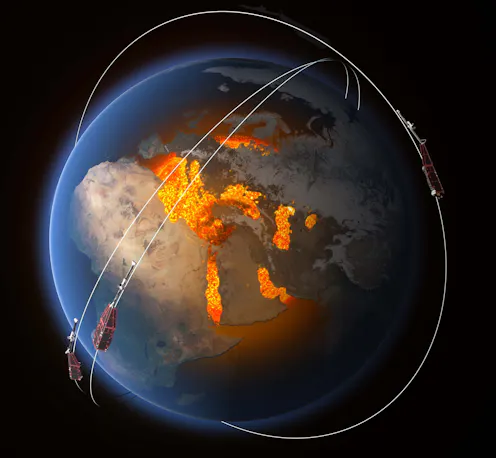
ESA’s Swarm constellation reveals new rapid changes of our magnetic field, tied directly to the heart of our planet’s molten iron core. ESA/ATG Medialab

Earth’s magnetic heartbeat, a thinner past and new alien worlds

Space research never stops and it seems neither do the surprises. On ABC Breakfast News I covered some huge results from the last few weeks. Be still my beating (magnetic) heart Earth’s magnetic field…
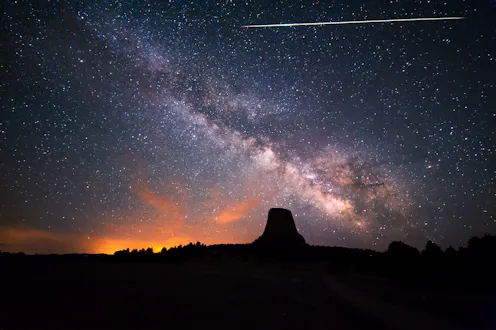
A stunning morning Eta Aquarids meteor shower above Devil’s Tower. David Kingham / flickr

Thanks Super New Moon for a great meteor shower

For those of you needing to escape the (Australian) budget this week, the cosmos has produced a perfect distraction with the regular and reliable meteor shower, the Eta Aquarids, to give you a reason to…
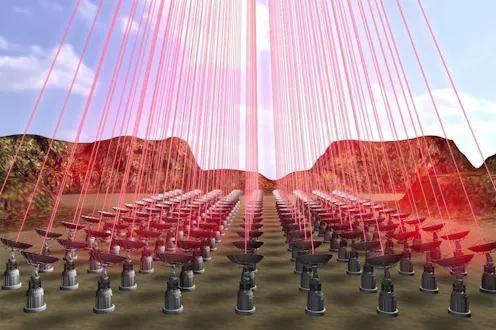
The impressive proposed laser propulsion system of Breakthrough Starshot. Breakthrough Initiatives

Interstellar travel, galactic cannibalism and Martian beer

Every other Monday morning I get to chat on ABC Breakfast News TV and try to remember that not everyone at 7.30am is as excited about exploding stars or colliding galaxies as I am. This week though I had…
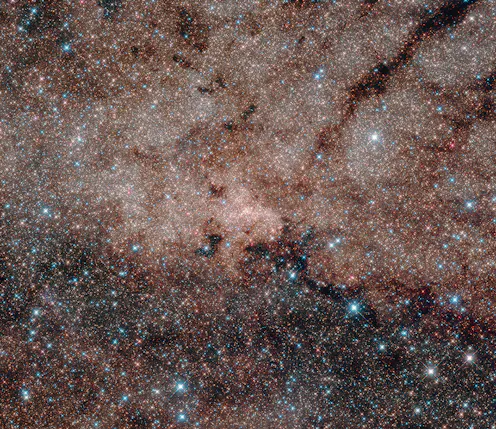
Except for a few blue foreground stars, the stars are part of the Milky Way’s nuclear star cluster, the most massive and densest star cluster in our galaxy. NASA, ESA, and Hubble Heritage Team (STScI/AURA, Acknowledgment: T. Do, A.Ghez (UCLA), V. Bajaj (STScI)

Hidden stars, baby planets and blowup spaceships

Each fortnight I get the amazing opportunity to speak about my top stories in space on ABC Breakfast News TV but for those of you who hate early mornings I wanted to make sure you got to hear of these…
The closest white dwarf to Earth just 8.6 light years away as seen by NASA’s Hubble Space Telescope and it’s not the obvious bright object in the centre (the Dog-Star Sirius) but rather orbiting it at bottom left is a tiny point of light. This is Sirius B, a companion white dwarf with nearly as much mass as our Sun but smaller in size than Earth. NASA, ESA, H. Bond (STScI) and M. Barstow (University of Leicester)

Something new under a (dead) sun

For all their enormous size and furious energies, stars are remarkably simple. Knowing just their mass and the smattering of elements heavier than hydrogen we can predict their lives from cradles to grave…
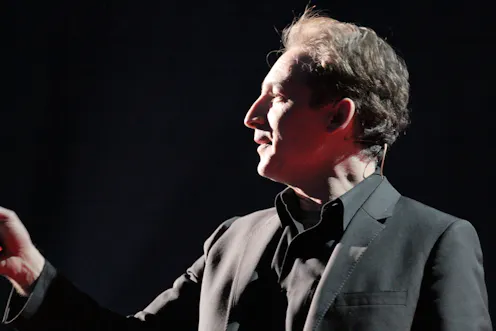
Stellar science communicator. Red Maxwell/Flickr

Brian Greene yes but string theory no

Saturday 19th March will see me standing on stage at Melbourne Park chatting to one of the most famous figures in physics and string theory, Professor Brian Greene, as part of his Think Inc tour of Australia…
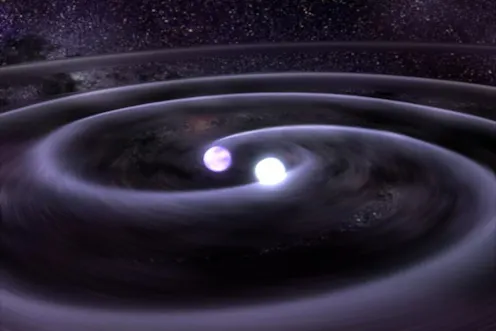
Massive bodies can send ripples through space time in the form of gravitational waves. NASA

Gravitational waves discovered: top scientists respond

The long awaited discovery of gravitational waves has sent ripples through the scientific world. Here top experts respond to the historic announcement.
NASA’s Juno probe will be the fastest object humanity has ever created when it approaches Jupiter. NASA/JPL-Caltech

Exploring the solar system: the best of what you can look out for in 2016

From the high-speed journey to Jupiter to solar eclipses, meteor showers and planetary alignments visible in the skies above – add these space highlights to your 2016 calendar.
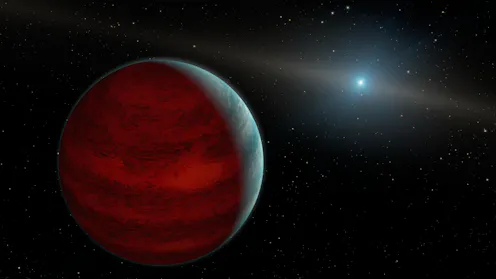
A highlight of 2015 was the number of weird and wonderful exoplanets that were found. NASA/JPL-Caltech

Space in 2015 was out of this world

From a flyby of Pluto to the search for extrasolar planets and gravitational waves, 2015 was a monumental year for space news.

Contact Alan for

  • General
  • Media request
  • Speaking request
  • Consulting / Advising
  • Research collaboration
  • Research supervision