

South Africa’s history shows that anti-immigrant violence is neither an aberration nor the country’s only possible path.
University of Oregon

The University of Oregon is a public, coeducational research university in Eugene, Oregon, United States. UO was founded in 1876 and graduated its first class two years later.
The Carnegie Foundation classifies the University of Oregon as a Tier 1 RU/VH (very high research activity) university. It is one of 108 universities to have such a designation. Additionally, the UO is one of only two Association of American Universities members in the Pacific Northwest.
As a flagship university of the Oregon University System, the UO is one of the nation’s many public teaching and research universities. As of Fall 2012, UO offers 269 degree programs, including highly nationally-ranked graduate programs in Biology, Business, Education, Environmental Law, Geological Sciences, Physics, Psychology, Sports Marketing, and Sustainable Design.
As of March 2012, University of Oregon faculty and alumni include two Nobel Prize recipients, 10 Pulitzer Prize winners, 19 Rhodes scholars, four Marshall scholars, 58 Guggenheim Fellows, and 129 Fulbright scholars.
Links
Articles

The court’s narrow opinion backing Fed governor Lisa Cook against Trump referenced the Fed’s vital role in steering the US economy.

With invalid driver’s licenses and birth certificates, transgender people are at risk for more than just steep fines and imprisonment.

This is not a typical employment law case because Lisa Cook, a member of the Federal Reserve Board, has far more legal rights to her job than most American workers.

Pretty isn’t always profitable.
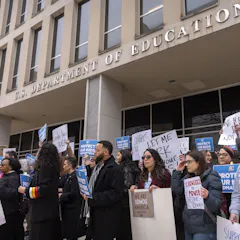
The justices overruled a lower court that had paused the Trump administration’s plan to fire over 1,300 workers.

A 1952 law that President Harry S. Truman opposed, calling it a step backward, now underpins many actions by the Trump administration against noncitizens in the US.

A federal judge had previously blocked the Trump administration’s plans to deport immigrants to third-country destinations, but some of them have remained detained in another African county, Djibouti.

Its actions are in keeping with Project 2025, which questions whether any public-sector unions should exist.

The Alien Enemies Act, first used in the late 1700s, was last invoked during World War II.
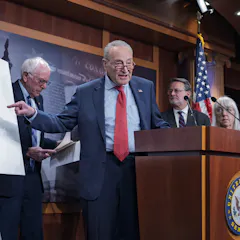
The layoffs further complicate staffing shortages at the Office for Civil Rights, which plays a vital role in promoting a fair education for public school students.

Federal grants and contracts are a major source of funding for nonprofit services in the US.

The Alien Enemies Act, first approved in the late 1700s, was last used during World War II to identify particular foreign nationals living in the US.

On July 4, 1891, Oklahoman farmer Oscar Weber Bilby served his neighbors the very first hamburgers on buns.
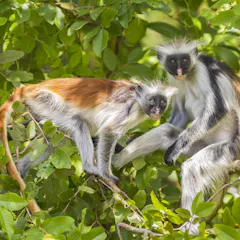
The 17 types of red colobus monkey living in Africa’s forests are among the first large mammals to be killed off by hunters. Protecting the red colobus could therefore protect the entire forest.

Understanding how humans came to exert such enormous pressure on Earth’s ecosystems can inform more sustainable ways of living.

The majestic white shark that once drew many tourists to South Africa’s western and southern Cape regions has all but disappeared. The only explanation can be a sharp decline in the population.

Despite making similar efforts for decades, the UAW union had never before managed to organize employees of foreign-based automakers in a Southern state like Tennessee.

Despite intermittent efforts over the past three decades, the UAW union has been unable to organize employees of foreign-based automakers in states such as Alabama and Tennessee.
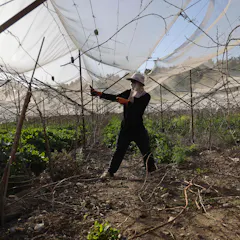
The contours of the Middle East conflict have long influenced Israel’s migrant worker policy.
Authors
-

Ph.D. Candidate, Lundquist College of Business, University of Oregon
-
Professor Emeritus of History and Labor Education, University of Oregon
-
Assistant Professor of Political Science, University of Oregon
-
Professor of Political Science, University of Oregon
-
Associate Professor of Planning, Public Policy and Management, University of Oregon
-
Assistant Professor of Italian, Migration, and Global Media Studies, University of Oregon
-
Professor of Law, University of Oregon
-
Assistant Professor, Department of Global Studies; Director of Food Studies, University of Oregon
-
Associate Professor of History, University of Oregon
-
Assistant Professor, Journalism and Director of Graduate Studies, Richard T. Robertson School of Media and Culture, University of Oregon
-
Associate Professor of Anthropology, University of Oregon
-
Associate professor of Education, University of Oregon
-
Courtesy Faculty, Oregon State University, Fisheries, Wildlife, and Conservation Sciences Department, University of Oregon
-
Professor of Anthropology, University of Oregon
-
Executive Director, Museum of Natural and Cultural History, University of Oregon