

Whether the enduring face of this new politics is Bobi Wine or someone else, Ugandan politics is clearly changing
Articles on Yoweri Museveni
Displaying 61 - 80 of 81 articles

Ugandan President Yoweri Museveni’s grip on power remains strong but pockets of dissent are emerging from digital platforms.
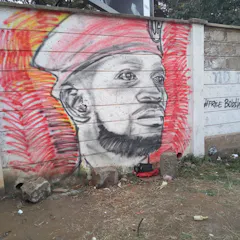
Social media has played a central role in attracting attention to the story of Ugandan politician Bobi Wine across the world.
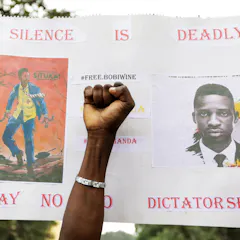
Bobi Wine entered the political arena with a relatively consistent background of politically critical music.
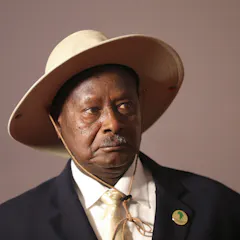
Uganda’s President Yoweri Museveni has been given the green light to run for another term. He should be happy, but he’s not.
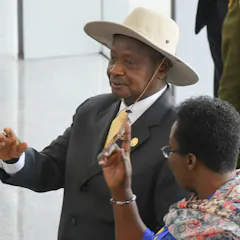
Not all African leaders are willing to be swept by the democratic reforms of the early 2000s.

Some young East Africans believe that there is nothing wrong with corruption – except in Rwanda.
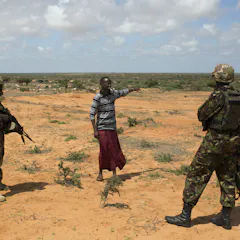
Kenya cited national security when it crossed into Somali territory in pursuit of Al-Shabaab militants. But there were numerous other potential aims at play.
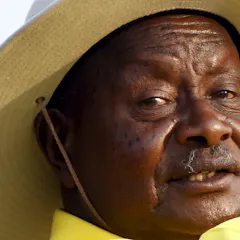
As a young radical in the 1980s, Museveni publicly scorned African rulers who clung to power. Now, after 30 years in office, he is clearly clinging pretty hard himself.
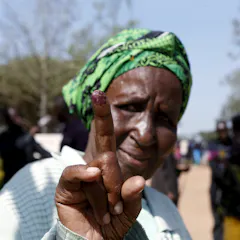
The outcome of the race between increasingly artful electoral manipulation and limitless possible manifestations of democratic expression is never entirely certain.

Uganda’s economy has seen many changes since independence. Trends in recent years are positive, although some key challenges remain.

Uganda has won praise for the way it treats its refugees. But now it is at breaking point.
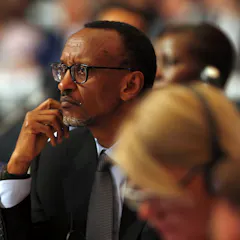
A Trump presidency brings into question America’s traditional approach to Africa, especially Rwanda. But a true shift in US foreign policy in Africa is not a priority for the Trump administration.

The Gambian election dispute is not the first that ECOWAS has confronted. Côte d’Ivoire’s 2010 presidential election is a case in point. There it resorted to military action to enforce the outcome.
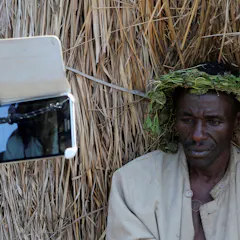
It comes as no surprise that nationhood in Uganda is still an elusive idea. Many people associate with their ethnic groups more affectionately than with their country.

The Kenyan example illustrates the importance of constitutional guarantees for devolution. But it also shows that devolution is no magic bullet for the problems of corruption and ethnic politics.
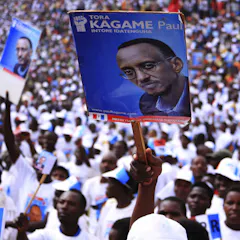
Africa’s democratic promise of the 1990s has lost its shine. Hopes for accountable rule have faded in Uganda, Ethiopia and Rwanda. All have blocked the path to meaningful popular empowerment.
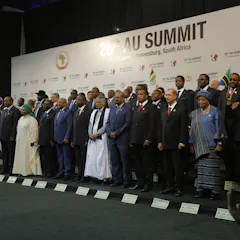
Silencing the guns in Africa by 2020 will require a Herculean effort on the part of the AU Peace and Security Council, whose remit is to prevent, manage and resolve conflicts.
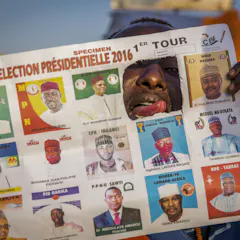
African elections and referendums are still a heady mixture of the graceful and the shameless.
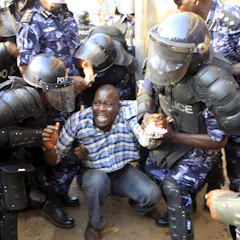
The heavy-handed tactics used by Uganda’s authorities during the 2016 elections have raised questions about a return to an oppressive past.
Top contributors
-

Assistant Professor of Political Science, Marist College
-
Professor in International Development, University of Antwerp
-
Professor of Anthropology and International Development, The University of Western Australia
-
Ali Mazrui Professor of History & African Studies, University of Michigan
-
Lecturer, RMIT University
-
Lecturer of Mass Communications, Uganda Christian University
-
Emeritus Professor of Law and Politics Institute of Development Policy (IOB), University of Antwerp
-
Professor of Democracy, University of Birmingham
-
Post Doctorate Researcher under the DANIDA funded project on security, sustainable growth and peace in Uganda., University of Copenhagen
-
Postdoctoral Research Associate, King's College London
-
Professor of Comparative Politics, University of Warwick
-
Jimmy Spire Ssentongo is an Associate Dean (Research and Publication), School of Postgraduate Studies and Research at Uganda Martyrs University, Uganda Martyrs University
-
Lecturer, University of York
-
Professor of World Politics, SOAS, University of London
-
Professor of History, Durham University