
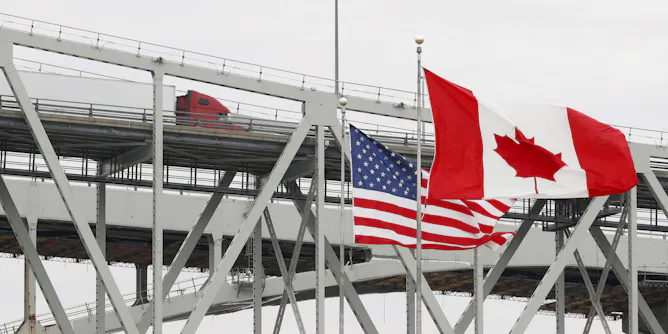
Trump’s use of a trade tool created during the Great Depression helped trigger a trade war between the two border countries, with few signs of de-escalation in sight.
Articles on US-Canada border
Displaying all articles
Should Canadians be worried about travelling to the U.S., given the current political climate? Here’s what two experts say.
The Canadian government’s announcement of the expansion of border security and surveillance measures could place more asylum seekers at risk.
Focus on supposed ‘loopholes’ that allow migrants to claim asylum echoes Canada’s longstanding preoccupation with how people negotiate the border.

The recent deaths of migrants trying to cross the Canada-U.S. border through Indigenous territory highlight the history of colonial dispossession that the border represents.

The renegotiated Safe Third Country Agreement was politically expedient for Justin Trudeau’s government, but poses real policy and programming challenges.
Migration expert Christina Clark-Kazak explains the devastating consequences of the recent change to the Safe Third Country Agreement made by U.S. President Biden and Canadian Prime Minister Trudeau.
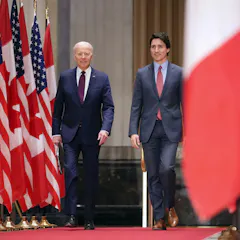
Canada and the U.S. have effectively decided to crack down on migrants crossing unofficial border points into Canada. Here’s why this approach misses the bigger picture.
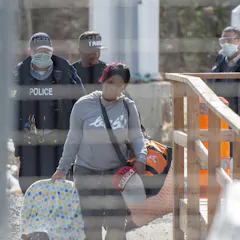
People don’t give up their right to be mobile or their right to make decisions about their lives simply because they are forced to flee untenable circumstances.

Cleaning up the Great Lakes was a big job when the US and Canada undertook it in 1972. Today it’s far more challenging.
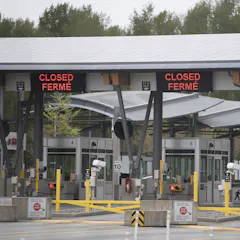
Current travel restrictions aren’t applied uniformly for air and land travellers. Similar restrictions need to be applied to land border crossings to curb the spread of COVID-19 and its variants.

Canadian government travel restrictions are an attempt to curb the spread of COVID-19 variants. But vague language around exemptions for medical travel may confuse the physicians who can grant them.

Nurses on both sides of the border report that they aren’t getting the support they need to feel safe on the job and maintain their own health and well-being during the COVID-19 pandemic.

The U.S. wanted to use the coronavirus pandemic as a reason to send the military to its northern border. The idea is part of America’s desire to “Mexicanize” the world’s longest undefended border.
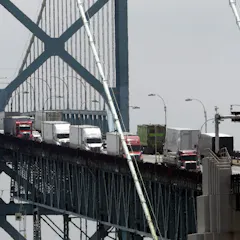
Canada and the United States have opted to keep its border open to commercial trucking during the coronavirus pandemic. The decision is important to the economies of both countries.
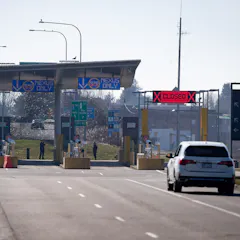
Canada’s ban on foreign travellers is not consistent with the science of the pandemic or Canada’s own values of inclusion and openness to outsiders.
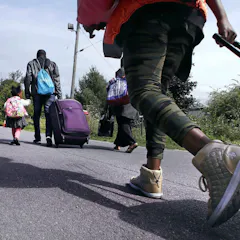
Canadian leaders have desperately tried to preserve the country’s image of liberal humanitarianism at our border, but the reality is Canada’s immigration history is built upon exclusion.
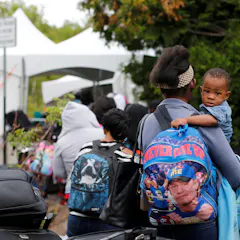
Unlike prior waves like the enslaved people on the Underground Railroad or Vietnam-era war resisters, they are children whose parents fear deportation after spending years in the United States.
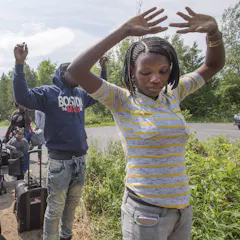
Rather than closing a loophole in a Canada-U.S. agreement that allows Canadian officials to turn back asylum-seekers from the U.S. at the border, the deal should be abolished outright.
Top contributors
-

Associate Professor, Health Sciences, Simon Fraser University
-
Director, Centre for Refugee Studies & Associate Professor, Osgoode Hall Law School, York University, Canada
-
Associate Professor of History, Carleton University
-
Professor, Department of Geography, Simon Fraser University
-
Professor, Public and International Affairs, L’Université d’Ottawa/University of Ottawa
-
Professor and Tier 1 Canada Research Chair in Global Health Governance; Scientific Co-Director, Bridge Research Consortium, Simon Fraser University
-
Associate Professor of Law, Queen's University, Ontario
-
Associate Professor, Nursing, University of Windsor
-
Researcher, Co-Investigator, Department of Geography, University of Lethbridge
-
Associate Professor of Environment and Sustainability, Western Michigan University
-
Canada Research Chair in Critical Border Studies and Associate Professor of Geography and Environment, University of Lethbridge, University of Lethbridge
-
Assistant professor of clinical psychology, University of Windsor
-
Research Fellow, Pandemics & Borders Project, Simon Fraser University
-
Associate Professor of Psychology, University of Windsor
-
Professor, Johnson Shoyama Graduate School of Public Policy, University of Regina