
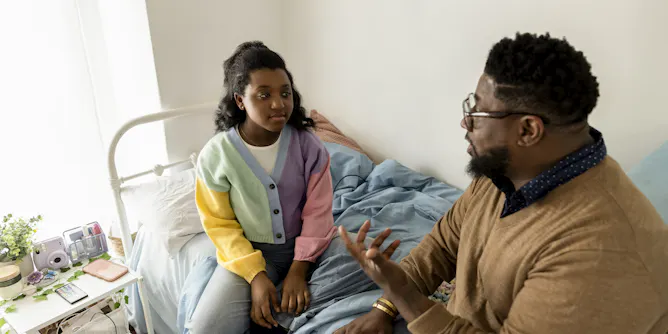
Teens fare better when both fathers and mothers play key parenting roles, including talking with them about sensitive subjects that were once considered only a mom’s role.
Articles on Sex ed
Displaying 1 - 20 of 26 articles

Semen, sperm, pre-cum, seminal fluid. These terms are sometimes used interchangeably – here’s the difference.

Comprehensive sex education has benefits, but the birds and the bees appear to be a taboo topic for some families.

Although there is a strong rationale for using popular media to confront sexual assault, many teachers identify and experience barriers to doing so in their classrooms.

Bringing discussion about aftercare into the negotiation of sexual consent encourages deeper conversations about what people want and need for safe, respectful and pleasurable sex.

Dating apps have changed how men interact with women when pursuing heterosexual relationships. A sexuality scholar writes about her experiences online, and her observations on changing masculinity.

Social media platforms can be a gateway for young people who need to access essential resources and support services.

Transparent public discussions are needed around how ‘sex,’ ‘gender identity’ and ‘gender expression’ are being defined and given effect in education, law, public policy and beyond.

Lots of kids wonder about this. Here are some of the basics.

Research shows that many girls are in elementary school when they have their first period. But often they have not received adequate health education.

Pleasure-based sex education allows young people to safely explore and develop critical thinking around sex and relationships.

Oral sex is common among young people. Protection from STIs is not.

Teens deserve to be empowered by knowledge of the pleasures of sex.

Results from our preliminary study strongly challenge the assumption that Indonesian parents are barriers to the delivery of school-based sexual health education.

When it comes to teaching about cycles in schools, the period dominates the story — but it’s important we teach about the ovulation part of the cycle, too.

As teens forge their post-pandemic identities, let’s afford them the ‘dignity of risk,’ in their whole lives including their sexualities.

People may not be using condoms at the same rate as before, but it is difficult to know for sure because there is a lack of data.

Parents can play an important role helping youth navigate the messages they see on YouTube about sexual consent.

Progressive responses that problematize Ontario’s new opt-out policy for sex ed might reinforce the misleading idea that parents are an obstacle to their children’s sex education.

Youth who are sexting are four times more likely to be having sex. They are five times more likely to have had multiple sexual partners and twice as likely not to be using contraception.
Top contributors
-

Principal Research Fellow, Australian Research Centre in Sex, Health and Society, La Trobe University
-
Professor, Faculty of Education;, York University, Canada
-
Senior Lecturer, School of Education, Edith Cowan University
-
Emeritus Professor of Sociology, Monash University
-
Doctoral Candidate, Department of Sociology, University of Calgary
-
PhD student in Clinical Psychology, University of Calgary
-
Professor, Sociology, McMaster University
-
Instructor, Integrated Studies in Education, McGill University
-
PhD Candidate in Health Services Organization & Policy, University of Michigan
-
Medical Student, University of Michigan
-
Associate Professor, American University School of International Service
-
GP and Lecturer at Sydney Medical School, University of Sydney
-
PhD Sociology, Carleton University
-
Associate Professor of Family Medicine, University of Michigan
-
Sessional Instructor, Department of Educational Policy Studies, University of Alberta