
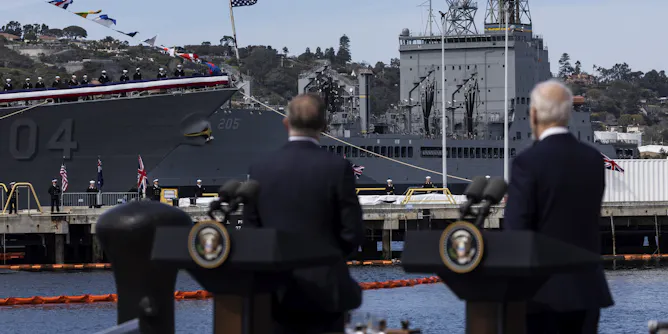
On the face of the announcements made so far, the deal complies with international law, despite accusations to the contrary from China and other critics.
Articles on nuclear submarines
Displaying 21 - 33 of 33 articles
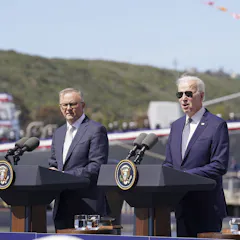
The plan will see Australia supplied with nuclear-propulsion submarines more than a decade earlier than preciously envisaged.
The first AUKUS-class submarine will be delivered in the 2040s. We may only get about a decade of use before adversaries can easily detect the new boats.
Albanese is expected to visit Washington in the next two weeks to announce the roadmap for the AUKUS submarine agreement.
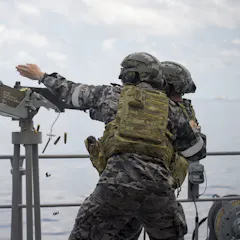
The long-awaited plan for Australia to get nuclear-powered submarines is expected next month, as are recommendations from a major strategic review into our defence force.
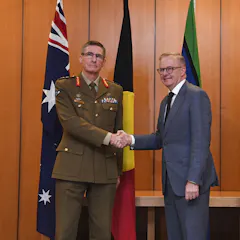
Australians are becoming more fearful in an insecure world, and want to see the country armed up, favouring more defence spending and the planned acquisition of nuclear-powered submarines.
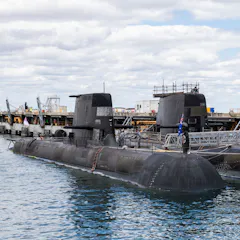
Michelle Grattan discusses politics with politics + society editor, Amanda Dunn

Politics with Michelle Grattan: Peter Dutton works on faster timetable for nuclear-powered subs
Michelle Grattan speaks with Defence Minister Peter Dutton about AUKUS, nuclear submarines and Australia's relationship with China and Russia
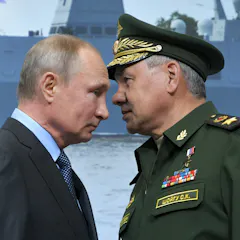
While all eyes are on China’s response to the new AUKUS security pact, Russia matters, too. After all, it has its own nuclear submarines that could now be marketed all over the region.
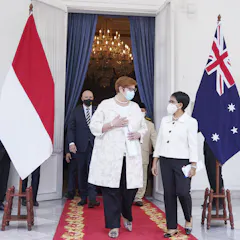
ASEAN countries fear a potential arms race and future confrontation between great powers taking place in their region.
The submarine announcement is sure to trigger a new round of debate on whether nuclear energy is right for Australia. But let’s be clear: the technology makes no sense for Australia.
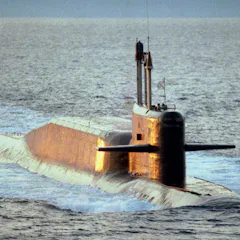
Nuclear submarines are powered by a miniature onboard fission reactor. They can go for decades without refuelling, making them faster, stealthier and much more expensive than conventional submarines.
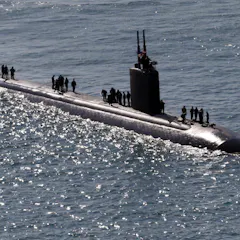
Nuclear-powered submarines do not need to surface for air, allowing them to be stealthier for longer. But there’s still a million-dollar question: does this make us safer?
Top contributors
-

Professor, Strategic and Defence Studies Centre, Australian National University
-
Professorial Fellow, University of Canberra
-
Emeritus Professor, School of Environment and Science, Griffith University
-
Associate Professor (Adj), Griffith Asia Institute; and Fellow, Strategic and Defence Studies Centre, Australian National University
-
Visiting Fellow, School of Global Studies, University of Sussex; University of Tartu; Utrecht University
-
Professor of Science & Technology Policy, SPRU, University of Sussex Business School, University of Sussex
-
Adjunct professor, Flinders University
-
Emeritus Professor of Complex Systems Science, Crawford School of Public Policy, Australian National University
-
Adjunct Associate Professor, The University of Queensland
-
Research fellow, Australian National University
-
Associate professor, Australian National University
-
Professor, School of Economics, The University of Queensland
-
Research Fellow, Foreign Policy and Defence Program, USSC, University of Sydney
-
Research Fellow, School of Regulation and Global Governance, Australian National University
-
Lecturer in Peace Studies and International Development, University of Bradford