
Interviews with 25 men from seven African countries revealed that some abused men choose to control their reactions, associating real manliness with non-violence.
Articles on Non-violence
Displaying all articles
In most cases, it’s reasonable to expect that groups of protesters will abide by the law. But there are times when doing so diminishes the effectiveness of the protests.

Elizabeth Gilbert’s decision to cancel the publication of her latest novel needs to be understood in the context of a long history of symbolic protest.
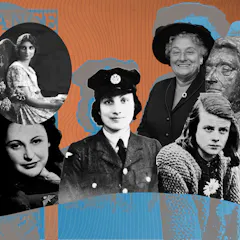
Could non-violent action by women ultimately replace military violence? There is much to learn from the bravery of female-led resistance movements during the second world war.

Nonviolent protest could also prove effective in stopping hostilities in Ukraine.
Fanon was brutally honest in his criticism of militants and Africa’s post-independence elites.
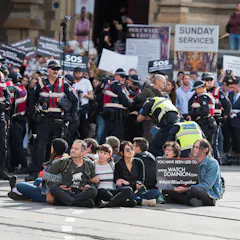
When the government claims that only non-disruptive protests are “civil”, it risks censoring those who seek to go beyond mere symbolic actions and have some impact on others through their protest.
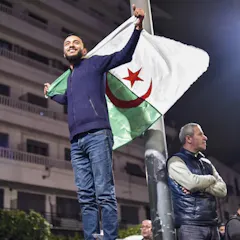
Young Algerians who dream of accessing global markets have extensively used iconic brands, films and series as political resources.
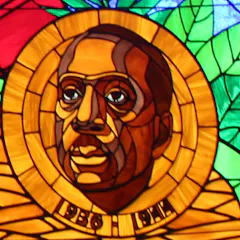
Howard Thurman, a mentor to MLK, first met Gandhi during a visit to India in 1936. He came to understand nonviolence as a force more powerful than hate that had the power to transform the world.
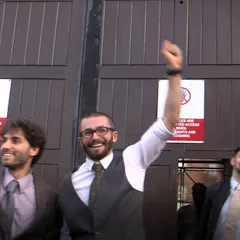
The criminalisation of fracking protesters is not the exception, it has become the rule.
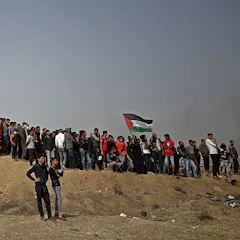
Palestinian nonviolent protests and mass movement of resistance is one of Israel’s biggest fears.
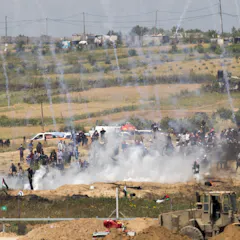
Thanks to a violent fringe of protesters backed by Hamas, a far larger non-violent movement is struggling to control the narrative of what’s happening in Gaza.
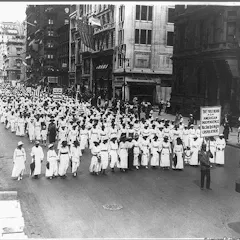
Thousands marched in silence against racial violence after a riot left hundreds of blacks dead and thousands homeless. The demands of black people in 2017 remain the same as they did in 1917.

It cuts shuts down the chance for dialogue.
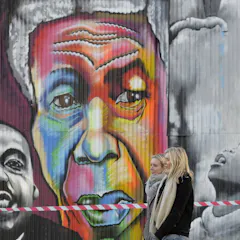
South African universities are aflame as student protests for free education turn violent. But, would a non-violent approach, as preached by Martin Luther King, be more effective in their cause?
Top contributors
-

Associate Professor in Peace Studies, University of New England
-
Senior Lecturer, Northumbria University, Newcastle
-
Lecturer in Conflict Studies and Middle East Politics, Trinity College Dublin
-
Research Fellow, Conflict Analysis Research Centre, University of Kent
-
Senior Counsel and PHD theological student at the University of Stellenbosch, Stellenbosch University
-
Samuel J. and Augusta Spector Professor of History and African and African American Studies, Brandeis University
-
Lecturer in Criminology, Edith Cowan University
-
Professor of Interdisciplinary Studies, Emerson College
-
Associate professor, Loughborough University
-
Professeur / Chercheur/ Consultant en marketing et sociologie de la consommation, Kedge Business School
-
Department Chair and Professor of Philosophy, Rochester Institute of Technology
-
Professor of Ethical Leadership, Boston University
-
Post Doctoral Research Fellow, African Centre for Evidence, University of Johannesburg
-
Senior Lecturer in International Politics, City St George's, University of London
-
Research Associate, Faculty of Humanities, University of Johannesburg