
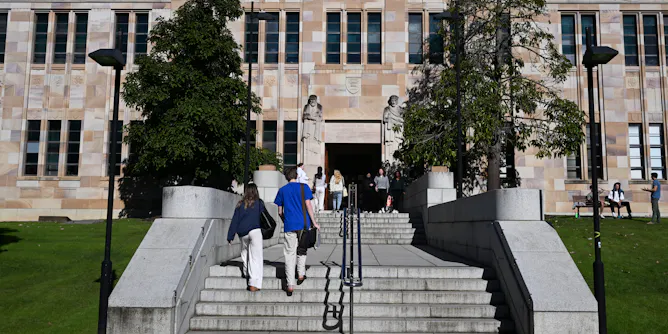
The federal government wants to boost the number of Australians from equity groups at university. But its new funding plans lack some important details.
Articles on needs-based funding
Displaying all articles

The Universities Accord final report proposes Australia adopts a ‘needs-based’ funding model. On top of base funding, there would be extra loadings to support equity students.
New analysis finds if Australian universities were treated like Australian schools, they would gain 11% in funding per year.

One recommendation to fix inequity in Australia is for the government to fund non-government schools to the same degree as government schools, while banning them from charging fees.
Schools funding doesn’t pass the playground test of fairness: state schools get less government funding than governments themselves say the schools need.

Needs-based funding is necessary, but it can only do so much. It’s much more effective if we don’t have schools with high concentrations of poverty and disadvantage.

A government review of regional, rural and remote education tells us we need to recognise the uniqueness of and understand successes in these communities to improve outcomes for these students.

We need to address issues like access to resources, teacher professional development and ageing classrooms to get the full benefit of STEM education in primary schools.

For the first time, Education Minister Simon Birmingham has proposed a credible plan to deliver needs-based funding.

A new proposed deal on school funding delivers the Gonski funding within budget.
Top contributors
-

School Education Program Director, Grattan Institute
-
Professor and Director, Mitchell Institute, Victoria University
-
Policy Fellow, Mitchell Institute, Victoria University
-
Associate Professor in Educational Leadership, Australian Catholic University
-
Professor (Curriculum Inquiry / Rural Education), University of Canberra
-
Research Fellow, Victoria University
-
Senior lecturer, Lead data scientist, Victoria University
-
Research Fellow, Mitchell Institute, Victoria University
-
Professor of Practice, School of Education, UNSW
-
Professor of Social Impact, University of Technology Sydney
-
Professor, Melbourne Graduate School of Education, The University of Melbourne
-
Professor of Education Policy and Comparative Education, Murdoch University
-
Democracy Deputy Program Director, Grattan Institute
-
Associate Professor, Teacher Education, University of Technology Sydney