
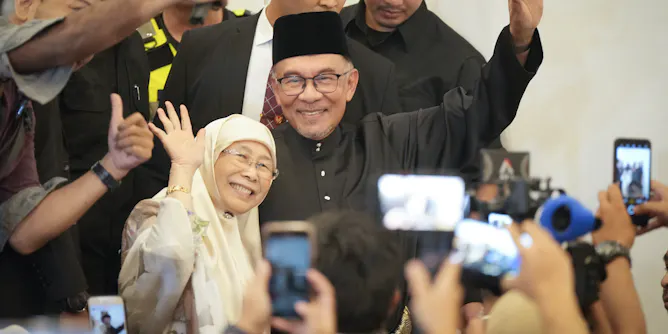
Can Anwar, the man who wrote a book on “his vision for a more tolerant, pluralistic Asia”, bring together a divided Malaysia?
Articles on Islam
Displaying 121 - 140 of 602 articles
Liberal schools of thought largely inform how Muslims are viewed across Europe, research finds.
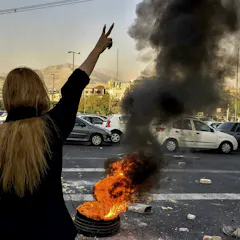
The veil as a symbol of oppression has once again moved to center stage in Iran, but it’s important to know about the history of veiling – and mandatory unveiling.
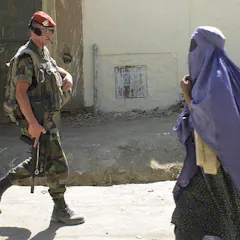
Pictures of women in war play a pivotal role in the battlefield of political ideas, argues a feminist historian who examines how images and attire are used and seen in war zones and occupied lands.

Religious belief in the devil may have declined, but western demons are alive and well in popular culture and contemporary politics.

As calls for greater freedom grow, the author examines how secularism might work in Iran.

Rosaries are meant to be used wherever, whenever – and each one tells a story.
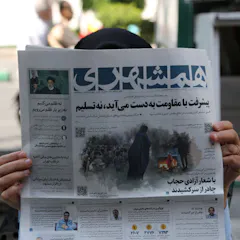
Controversy of veils goes back more than a century, a scholar of Iran explains.
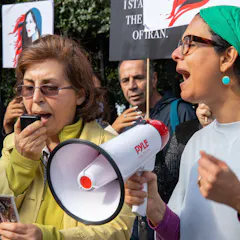
Protesters call for a change in rules over what women are forced to wear in Iran. An expert tells us what the law says.
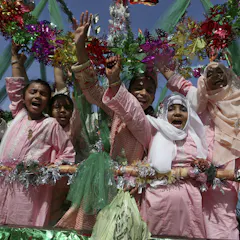
The Wahhabi school of Islam has spread throughout the world, along with its disapproval of the holiday.

Bohra women’s use of social media to build businesses is an example of how religious communities can help women gain financial independence.
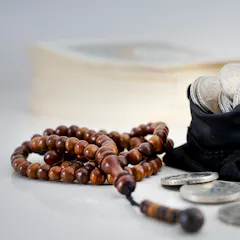
Shariah law informs financial contracts and credit systems, and the growth of Islamic financing options provides an alternative to current debt-based banking systems.
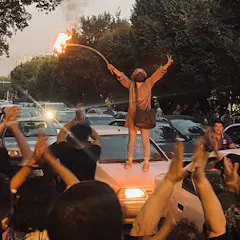
Data shows that more than half of Iranian women oppose the compulsory wearing of hijabs and that the vast majority oppose an Islamic Republic.
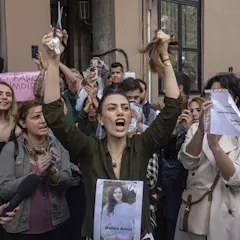
Feminist campaigners are using the internet to challenge the conservative establishment and empower Arab women.
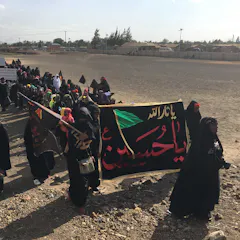
A variety of cultural performances evoking intense emotions occur during the Islamic month of Muharram. A scholar observed the processions on Ashoura in northern Tanzania.
Narcissism among young people is often associated with selfies and showing off on social media, but it can also take the form of religious expression or fanaticism.
Writers seem to be especially vulnerable in polarized times, when the nuances of works are more likely to be overlooked.

Study shows that so-called “socio-cultural attitudes” are not a plausible explanation for the Muslim penalty.
The attack on Salman Rushdie promptly led to speculation on whether the attacker had been influenced by the 1989 fatwa against the author. A scholar explains what a fatwa is, and isn’t.

The fatwa against Salman Rushdie has political significance beyond the threat to free speech.
Top contributors
-

Affiliate Researcher, Religion and Civic Culture Center, USC Dornsife College of Letters, Arts and Sciences; Bayreuth University
-
Associate Professor of Religious Studies, Florida International University
-
Research Fellow, Middle East Studies, Deakin University
-
Professor of Islamic Studies, Head of School, The Centre for Islamic Studies and Civilisation, Charles Sturt University
-
Associate Professor of Religious Studies, Western Sydney University
-
Professor of Political Science, Director of Center for Islamic & Arabic Studies, San Diego State University
-
Affiliated Faculty of Bioethics, Religion, and Society, Department of Religious Studies, DePaul University
-
Emeritus Professor in the History of Religious Thought, The University of Queensland
-
Assistant Professor of Philanthropic Studies, Indiana University
-
Director of the Curtin Extremism Research Network (CERN), Curtin University
-
Professorial Fellow, University of Canberra
-
Emeritus Professor of Sociology, University of Technology Sydney
-
Reader in Political Science and International Relations, Aston University
-
Honorary Research Associate, Te Kunenga ki Pūrehuroa – Massey University
-
Class of 1950 Herman B Wells Endowed Professor and Professor of Middle Eastern Languages and Cultures, Indiana University