

Should people aged 55 and over get a targeted boost to their JobSeeker payments? Our research suggests the need among young Australians may well be greater.
Articles on HILDA
Displaying 21 - 40 of 63 articles

Australia’s education system is not doing that well in correcting for the disadvantage students face in the classroom.

Controlling for other factors, the mental health cost of renting can be eliminated through longer tenure and greater security.

Rates of full-time employment and pay relative to other workers have fallen for the latest generation of new workers. Yet the HILDA Survey shows their reported job satisfaction has risen.

While most women who try for a baby will succeed, some won’t, and some will have fewer children than they had planned to have.

The change point at which the happiness of most Australians no longer strongly depends on income has almost doubled from A$43,000 to A$74,000.

When low-wage workers lose jobs the average wage goes up. There’s a better measure, but we’re not using it.

A report uses an international benchmark of no more than 7% of disposable income spent on childcare to determine affordability. It finds childcare is unaffordable for 386,000 Australian families.

The HILDA Survey suggests single-parent households on Australia are abandoning formal childcare as they face greater poverty rates.

Australians report high levels of life satisfaction but there are gaps — Indigenous Australians, immigrants and the unemployed fare worse. And COVID-19 won’t have helped.

It isn’t only because they are in worse jobs. it’s also because they are earning less from businesses.
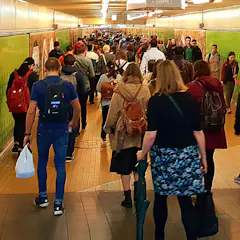
The mental health of young women is far more sensitive to unemployment than the mental health of young men.

Four decades on, and commencing retirement, Australians who entered the labour market during the 1970s recession are less happy than those born earlier or later.

Around 20% of young Australian women had a diagnosis of depression or anxiety in 2017 compared with 12.8% in 2009. But the proportion of people reporting significant symptoms has remained stable.
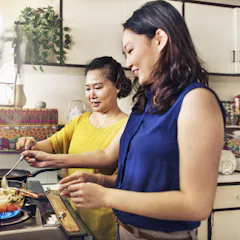
In 2017, 56% of men aged 18 to 29 lived with one or both parents, up from 47% in 2001. And over the same period, the proportion of women aged 18 to 29 living with their parents rose from 36% to 54%.

Surprisingly, Australian-born women are significantly more likely to live in an inter-ethnic relationship than their male counterparts.

The science of sleep and the economics of sleeplessness
The Conversation, CC BY52.8 MB (download)
Only about one quarter Australians report getting eight or more hours of sleep. And in pre-industrial times, it was seen as normal to wake for a few hours in the middle of the night and chat or work.

Use our drag-and-drop interactive to find out how incomes, financial wellbeing, and housing stress has changed since 2001 for various ‘family types’, including singles or couples without children.

Here are 10 trends worth noting from this year’s huge Household, Income and Labour Dynamics in Australia (HILDA) survey. For starters, household spending on energy fell, even as power prices rose.
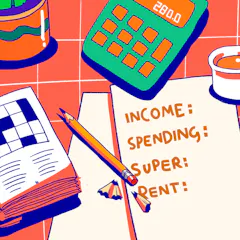
What the huge HILDA survey reveals about your economic well-being, health and family life
The Conversation, CC BY53.6 MB (download)
On today's episode, we'll hear what the huge HILDA survey says on Australians' financial literacy, energy use, how many of us are delaying getting a driver's license and how our economy is changing.
Top contributors
-

Professorial Fellow and Co-Director, HILDA Survey, Melbourne Institute of Applied Economic and Social Research, The University of Melbourne
-
Principal Research Fellow, Melbourne Institute of Applied Economic and Social Research, The University of Melbourne
-
Senior research fellow, The University of Melbourne
-
Adjunct Professor, School of Government and International Relations, Griffith University
-
Senior research fellow, The University of Melbourne
-
Professorial Fellow, The University of Melbourne
-
Associate professor, The University of Melbourne
-
Senior Research Fellow, Social Policy Research Centre, UNSW
-
Professor, Crawford School of Public Policy, Australian National University
-
Professor of Economics and Director, Tax and Transfer Policy Institute, Crawford School of Public Policy, Australian National University
-
Lecturer in Ageing and End of Life, La Trobe University
-
Professor, Bankwest Curtin Economics Centre, Curtin University
-
John Curtin Distinguished Professor, Curtin University
-
Senior research fellow, The University of Melbourne
-
Senior Research Fellow, Social Policy Research Centre, UNSW