
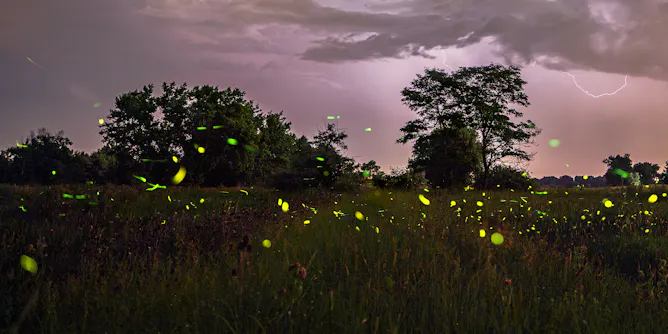
New research uses firefly flashing patterns to identify species and what they’re communicating.
Articles on Fireflies
Displaying all articles

About a third of insects attracted to artificial lights die by morning, often from exhaustion. But we can help them, and the vital ecosystems they serve, by reducing light pollution.
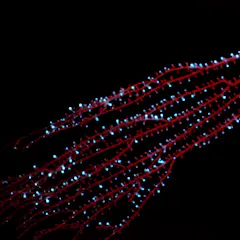
Dozens of animals, some on land but many in the ocean, can produce light within their bodies through chemical reactions. Scientists are still trying to understand when and why this trait developed.
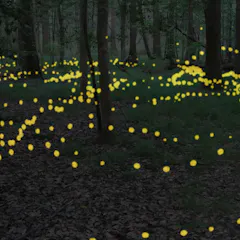
Synchrony is ubiquitous throughout the universe. But physicists’ equations predicted there could also be erratic exceptions marching to their own beat. Now they’ve been spotted in firefly swarms.
Plus, why fireflies need dark nights and what you can do about it. Listen to episode 19 of The Conversation Weekly.
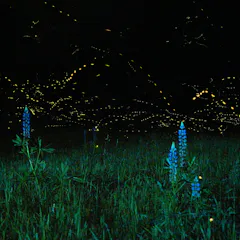
Fireflies’ summer evening light shows are a delight for humans, but for the insects they are a crucial mating ritual – and human-caused light pollution is a buzz kill.
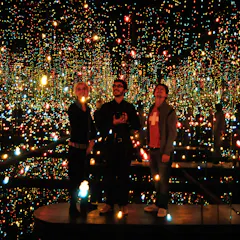
Images of wildfires are powerful, but can make climate catastrophe seem like something spectacular and distant. So some artists are focusing on the plants and bugs in our immediate surroundings.
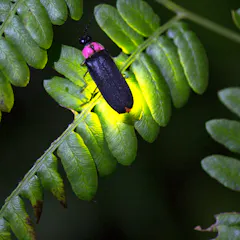
For many people, the gentle blinks of fireflies flashing are a favorite part of summer evenings. An entomologist explains some lightning bug basics.
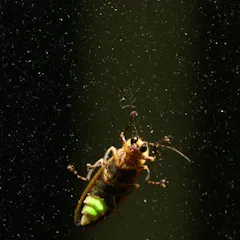
Beneath their beautiful, flashing facade some female fireflies are ruthless predators.
Top contributors
-

PhD Candidate in Biology, Tufts University
-
Research Zoologist and Curator of Corals, Smithsonian Institution
-
Professor of Entomology, North Carolina State University
-
Professor of Biology, Tufts University
-
Research associate, Cornell University
-
Associate Professor in Botany, University of Otago
-
Postdoctoral Associate in Biological Sciences, Florida International University
-
PhD Candidate in Zoology, University of Otago
-
Associate Professor of Secular and Religious Studies, Utrecht University
-
Provost Professor of Art History and English, USC Dornsife College of Letters, Arts and Sciences
-
Assistant Professor, Public Law and Governance, Tilburg University
-
Ph.D. Candidate in Computer Science, University of Colorado Boulder
-
Research scientist, University of Hohenheim
-
Associate Professor of Computer Science, University of Colorado Boulder