
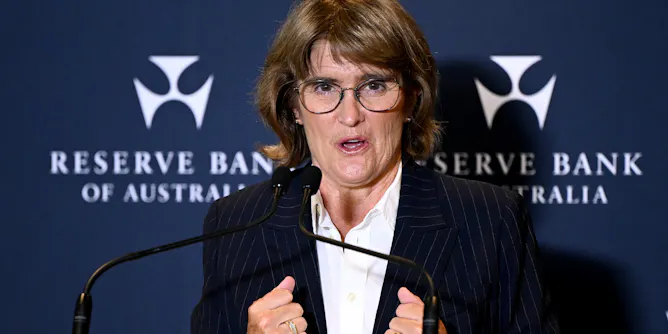
The central bank has also forecast higher inflation and slower economic growth.
Articles on Economy
Displaying 61 - 80 of 1249 articles

The days of rapid economic growth are long gone. New analysis helps explain what has changed.

Childcare responsibilities, housing access and regional cultural norms influence where Nigerian women work.

The Reserve Bank will make the call next Tuesday. It’s expected to raise rates to crack down on inflation, before it becomes entrenched.

And what might it mean for renters – especially rental housing supply and prices – if the government does tackle negative gearing?

In parts of Western Australia and Southern Australia, mouse numbers are reaching plague proportions.

Politicians and environmental groups are renewing calls for a 25% tax on Australia’s gas exports. An energy law expert explains how it would work.

We don’t inflation-proof any other parts of the tax system, so why should we give special treatment to capital gains?
The way we deal with rising inflation is highly problematic.

The make-up of the workforce is changing, with rapid growth in blue-collar jobs offsetting a decline in white-collar work.

Estimates of artificial intelligence’s impact on jobs and the economy range from the apocalyptic to the utopian, but the data tells a more nuanced story.

China stands to be impacted first, as the main buyer of Iran’s crude oil. But if the blockade drags on, its knock-on effects could impact the whole world.
Economic activity is still solid for now – but these are the risks ahead.

Virtue-signaling and self-care help explain a popular new kind of splurge, even as American shoppers pull back elsewhere.

As the Middle East and Gulf lose their image of stability, other destinations are becoming more attractive.

The changes announced by the prime minister won’t help with supply and are poorly targeted.

Modelling shows higher costs affecting freight, food production, and manufacturing – pushing up the cost of all kinds of goods, from steak to steel.

Cut off from the world’s main financial messaging system, Russia turned to a domestic alternative. But research shows it fell far short of replacing the global financial network.

Reducing the rate of compulsory super is also unlikely to help with housing affordability.

Modern economies are better prepared for an energy shock than in the 1970s, but there are still big risks ahead.
Top contributors
-

Senior lecturer, Canberra School of Government, University of Canberra
-
Professor of Economics & Business, Allegheny College
-
Professorial Fellow, University of Canberra
-
Associate Professor of Business, Boston University
-
Associate Professor, School of Economics, University of Sydney
-
Professor of Economics, University of Canberra
-
Professor of Economics, University of Nebraska Omaha
-
Visiting Professor at the Business School, University of the Witwatersrand
-
Associate Professor of Finance, Mississippi State University
-
Associate Lecturer, University of Aberdeen
-
Distinguished Professor, Arthur J. Gosnell Professor of Economics, & Head, Department of Sustainability, Rochester Institute of Technology
-
Senior Lecturer in Economics, The Open University
-
Professor, and Executive Director: Institute for International Trade, and Director of the Jean Monnet Centre of Trade and Environment, Adelaide University
-
Professor, Centre of Policy Studies and the Impact Project, Victoria University
-
Senior Lecturer in Economics, University of Sydney