
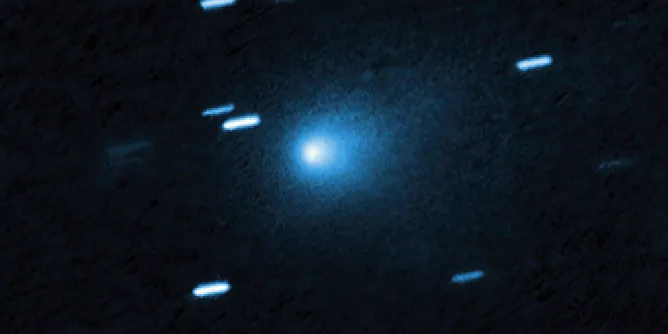
The chemical constituents of 3I/Atlas are a sign of its exotic origin.
Articles on Comets
Displaying 1 - 20 of 103 articles
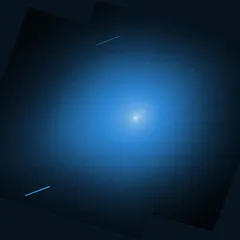
A process called ‘hot bottom burning’ helped scientists determine the age of 3I/ATLAS.
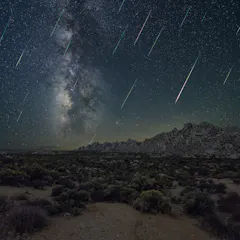
An observatory director describes the differences between the types of rocks that fly through space.

Astronomers will investigate this fireball to help disentangle the heritage and history of the Solar System’s formation.
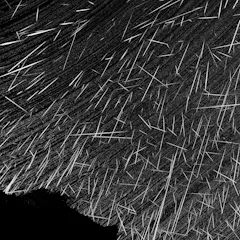
A newly identified meteor shower reveals that intense heat is fragmenting a previously unknown asteroid as it passes too close to the Sun.

Comet MAPS has the potential to be one of the ‘Great Comets’ of this century.

Or perhaps there was no star at all.
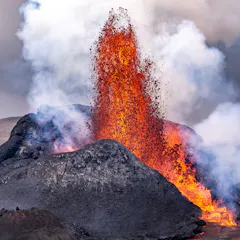
New research suggests that a mystery platinum signature found in Greenland’s ice may have come from a volcanic eruption in Iceland.
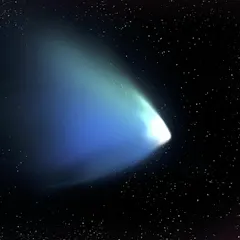
If you’re like most people, you’ve never heard of it. Meet the ringed asteroid-comet hybrid prowling the outer reaches of the Solar System.

Use our interactive globe to see if you’re in the ‘zone of disappointment’ for the Perseids – then save these dates for better meteor showers to watch.
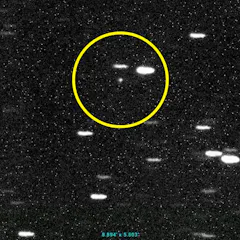
An object dubbed 3I/ATLAS is only the third interloper from outside the Solar System seen in all of human history.
Over the next few days, astronomers will pull together evidence to determine whether the object is a comet.
The space agency faces major competition from rising space powers such as China and India.
At the very beginning of its history, Earth was dry. How did it become a blue planet? A new theory could provide an answer.
Comet C/2024 G3 (ATLAS) will be visible just after sunset in the coming nights.

Comets without tails, called dark comets, are a newly discovered space object. Now, astronomers know they come in 2 classes.

In 2017, astronomers found an object they’d never seen before. Now, it’s part of a growing category of elusive ‘dark comets’ – and we might find more soon.

Comet Tsuchinshan-ATLAS is one of 2 comets from the Oort Cloud passing by Earth in October 2024.

Comet C/2023 A3 (Tsuchinshan-ATLAS) is expected to be the brightest spectacle of 2024. Our charts will help you find it in the night sky.
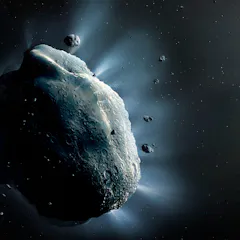
Asteroids aren’t supposed to emit gas when they get close to the Sun in the way that comets do, but Phaethon didn’t get the memo.
Top contributors
-

Professor (Astrophysics), University of Southern Queensland
-
Senior Curator (Astronomy), Museums Victoria Research Institute; The University of Melbourne
-
Professor of Planetary and Space Sciences, The Open University
-
Research Associate, The Open University
-
Lecturer, School of Science, Computing and Engineering Technologies, Swinburne University of Technology
-
Postdoctoral Fellow in Planetary Sciences, NASA
-
Co-Director Space Technology and Industry Institute, Swinburne University of Technology
-
Professor of Astrophysics, Queen's University Belfast
-
Director of the Abrams Planetarium, Michigan State University
-
Professor of Planetary Sciences, The Open University
-
Assistant Professor, Michigan State University
-
Lecturer in Ancient History, Cardiff University
-
Professor of Petrology, Queensland University of Technology
-
Adjunct professor, UNSW
-
Reader in Planetary Science, UCL