

The logic of the policy changes initiated by the Hawke government in mid-1990 has underpinned asylum-seeker policy for much of the quarter-century since.
Articles on Bob Hawke
Displaying 61 - 80 of 84 articles
There is little of Gareth Evans’ sweeping analysis in the cabinet papers of 1990-91 of a rapidly changing world order or of his vision of good international citizenship.
The National Archives of Australia today released selected federal cabinet records for 1990 and 1991. They reveal intense battles over Australia’s domestic climate targets and, above all, a palpable determination that Australia not damage its coal revenue.

While the press at the time focused on what Keating called “the Punch and Judy show”, cabinet papers reveal that the fourth Hawke government was working at an astonishing pace at reforms still felt today.
In the 1980s Australians grappled with the challenges of living in an era that brought together boom and crisis, nationalism and globalisation, confidence and anxiety, and conservatism and exuberance.

Mainstream Australia isn’t allowed to define multicultural priorities, as the policy has no legislative legitimacy.
In leadership contests in particular, the media’s role is often markedly different from the competition between parties.

When Australia’s government first pledged to set an emission-reduction target, Jon Bon Jovi was riding high in the charts. The progress made in the 25 years since has hardly been a blaze of glory.
In our modern age, reform means essentially mastering necessity – taking what steps are necessary to ensure that one’s country survives and prospers.
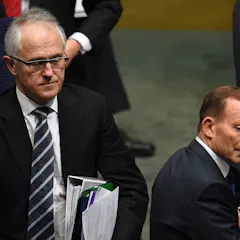
From Hawke-Keating to Rudd-Gillard, climate policy has an uncanny ability to cost Australian political leaders their jobs. And it was a key element in the rivalry between Tony Abbott and Malcolm Turnbull.
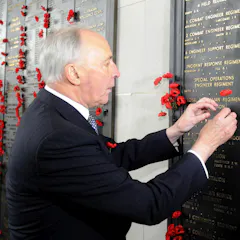
There is a complicated story involving the Anzac legend and the left between the 1920s and the 1960s which historians have barely begun to untangle.
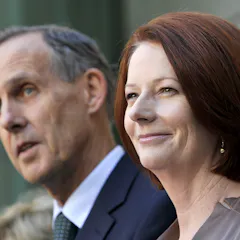
A political party that isn’t sure what it stands for isn’t really a party.
Malcolm Fraser may be remembered for his failure to intervene in the Franklin Dam campaign, but he otherwise led a government distinguished for its environmental action.
Malcolm Fraser used to argue that he had not changed his political position, but he had in significant ways. This personal evolution was a wonderful quality in the former prime minister.

A line-up of former prime ministers stake their rival claims to making Australia great, in a new series by journalist George Megalogenis.
The distinction between the global and the local is collapsing under the pressure of climate change, economic restructuring, global migration and jihadism on the one hand and the populist and information…
A recent public poll showed that of Australia’s recent federal treasurers, Peter Costello and even John Howard were rated higher than Paul Keating. Joe Hockey was rated the worst. Today’s release of the…
The Hawke government in the 1980s is widely considered to be the most competent and effective of recent years. Some may say this is not setting the bar terribly high, but the cabinet papers of 1988-89…
The following was delivered as the 2014 Dean Jaensch Lecture at Flinders University, September 16. In opposition, Kevin Rudd and Tony Abbott were fond of comparing their battles to become the nation’s…
The ABC’s four-part series of interviews with Paul Keating, which has just finished airing, displayed the former prime minister and treasurer in all his complexity, both at his best and at his worst. This…
Top contributors
-

Professorial Fellow, University of Canberra
-
Director, Vice-Chancellor's Centre of Public Ideas (CoPI) and Donald Horne Professor of History and Public Ideas, University of Canberra
-
Former Visiting Fellow, SPRU, University of Sussex Business School, University of Sussex
-
Emeritus Professor of Politics, Monash University
-
Senior Lecturer, School of Humanities and Social Sciences, Deakin University
-
Professor, Canberra School of Government, University of Canberra
-
Professor, Australian Studies Institute, Australian National University
-
Professor in History, Australian National University
-
Senior Lecturer, School of Political and Social Inquiry, Monash University
-
Scientia Professor of Economics, UNSW
-
Emerita Professor of Politics, Adelaide University
-
Senior lecturer, Canberra School of Government, University of Canberra
-
cultural policy consultant
-
Senior Lecturer in Law, Charles Sturt University
-
Jim Gillespie is a Friend of The Conversation.
Associate Professor in Health Policy, Leeder Centre for Health Policy, Economics and Data & Sydney School of Public Health, University of Sydney