
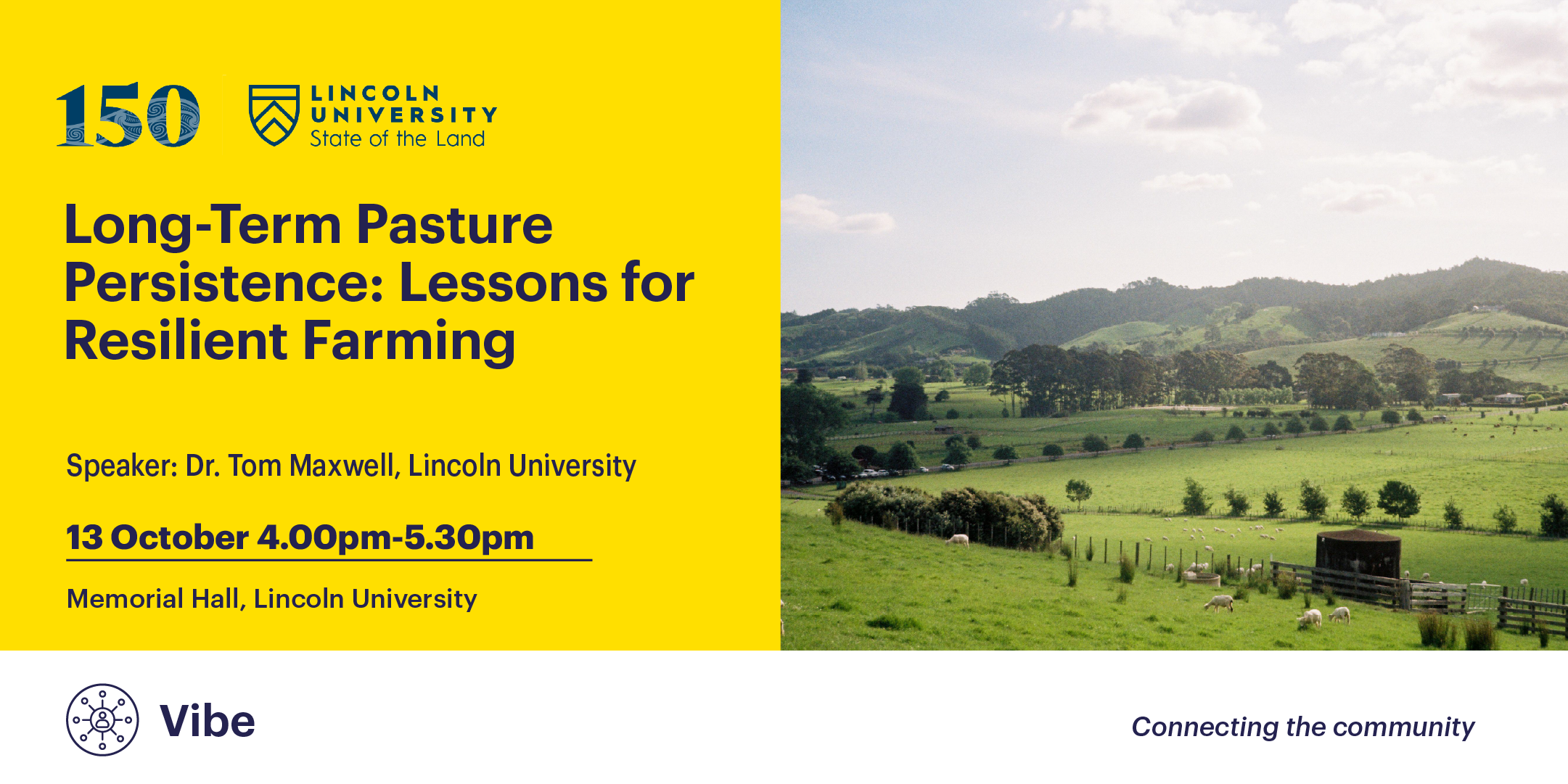
Pasture persistence is central to the productivity, profitability and resilience of New Zealand’s pastoral farming systems. But how well do different pasture species and cultivars actually perform over the long term – and how much does the establishment year influence what happens down the track?
For more than a decade, the Lincoln University Long-Term Pasture Persistence Trial has been building one of the country’s most comprehensive datasets on pasture performance. Based at Lincoln University’s Ashley Dene Research Farm and supported by the T.R. Ellett Agricultural Research Trust, the trial compares perennial ryegrass, cocksfoot and tall fescue cultivars through sequential annual sowings on the same farmlet.
The long-term data provide valuable insights into yield, botanical composition, tiller density and basal cover, revealing how genetics, establishment conditions and growing environments interact to shape pasture persistence.
At this VIBE event, Dr Tom Maxwell will share what the first ten years of the trial can tell us about growing persistent pastures in Canterbury’s challenging conditions. Working together on the project, they will explore why establishment conditions matter, what the data reveal about cultivar performance and how these findings could inform practical decisions for farmers looking to build more resilient pastures.
Join us for an engaging conversation about what long-term research can teach us about getting pastures to last – and what that means for the future of farming.
Tuesday 13th October 2026
4.00pm-5.30pm
Memorial Hall, Lincoln University
Timings
4:00pm – Arrival and networking
4:10pm – Welcome from Prof. Chad Hewitt, Provost, Lincoln University
4:15pm – Keynote presentation
4:45pm – Q&A
5:00pm – Networking
5:30pm – Event concludes
About Our Speaker

Dr. Tom Maxwell
My work investigates interactions between the biophysical environment, the grazing ruminants across it (dairy cattle, sheep, beef cattle and deer), and the grazing feed resource that brings it all together. My focus interest is understanding the ecological mechanisms that underpin the functioning of grazing lands for the purpose of informing context-appropriate applied management of these working landscapes in meeting the economic and social needs of humanity, while maintaining the biophysical resource on which the ecosystem rests. My research interests are diverse and transdisciplinary in the realm of grazing lands, holding a holistic lens on grazing lands sustainability in NZ and globally. The research I do encompasses forage-pasture agronomy and management, grazing ecology and management, soil-plant interactions, plant-animal interactions, ruminant nutrition of grazing systems spanning intensive to extensive scales, ruminant grazing syndromes, and agrivoltaics with grazing animals. Recent research activity has involved hill and high country pasture ecology, long-term sown pasture persistence, and diverse pasture species options for reducing the environmental footprint (nitrate leaching) of grazing systems. Previous research involved testing precision agriculture tools (thermal camera imaging and remote-sensing technology) for pasture yield assessment and management. I am the Academic Program Convenor for the Bachelor of Agriculture and Bachelor of Agricultural Science at Lincoln University.
Click here to see more events