
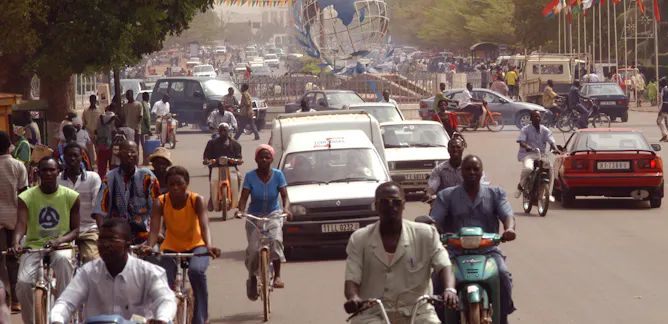
Avec l’explosion du trafic, la qualité de l’air se détériore à Ouagadougou. Un changement de cap de la mobilité s’impose.
Haramaya University

Haramaya University (HU) is one of the oldest higher learning institutions in Ethiopia which has gone through more than six decades of gigantic transformations since its establishment as an Imperial Ethiopian College of Agricultural and Mechanical of Arts (IECAMA) in the early 1950s. Its foundation was necessitated with the need for modernizing and advancing Ethiopia’s agriculture through the production of trained manpower and pragmatic research and extension programs. To this end, the governments of Ethiopia and the United States of America signed an Agreement under the Point Four Program on May 15, 1952. This was followed by the establishment of Jimma Agricultural Technical School and IECAMA. The Jimma School began to function as a source of and interim institution for the College students pending the foundation of an agricultural College. The Agreement between the Government of Ethiopia and the Technical Cooperation Administration of the Government of the United States of America was signed on May 16, 1952, which gave the mandate to Oklahoma State University (OSU) to establish and operate the College, carry out a nationwide system of Agricultural Extension via agricultural research and experimental station. Subsequently, with the recommendation of His Imperial Majesty, Emperor Haile Sellasie I, the envisioned IECAMA was established at its present location, Haramaya, near the historic Lake Haramaya. The area covers a total of 440 hectares of land. The establishment involved the construction of physical plant and enormous facilities of the campus including students’ dormitories, the cafeteria, the classrooms, the clinic, farm shop and staff dwellings largely in 1950s.
Links
Articles
Les réserves naturelles du Burkina Faso doivent être protégées. Elles constituent une halte pour les oiseaux qui migrent chaque année de l'Europe vers l'Afrique.
Burkina Faso’s little-known nature reserves need protection. They are a key stopover point for the 2.1 billion birds that migrate from Europe to Africa every year.

With the climate heating up rapidly, African cities must green every space to cool down and absorb more rain water, minimising floods. Nature-based solutions can make a huge difference.
